
An Agent Appliance Built for CEOs: A Conversation with 302.AI Founder Jomy
Crossing interviews Jomy about enterprise AI through CEO information needs, local deployment, small-model engineering, and traceable knowledge retrieval.
The larger the company, the further you are from the truth.


In 2025, much of the AI industry believes in the cloud, SaaS, and subscriptions. Zleap founder Jomy has instead made his latest product a substantial metal box.
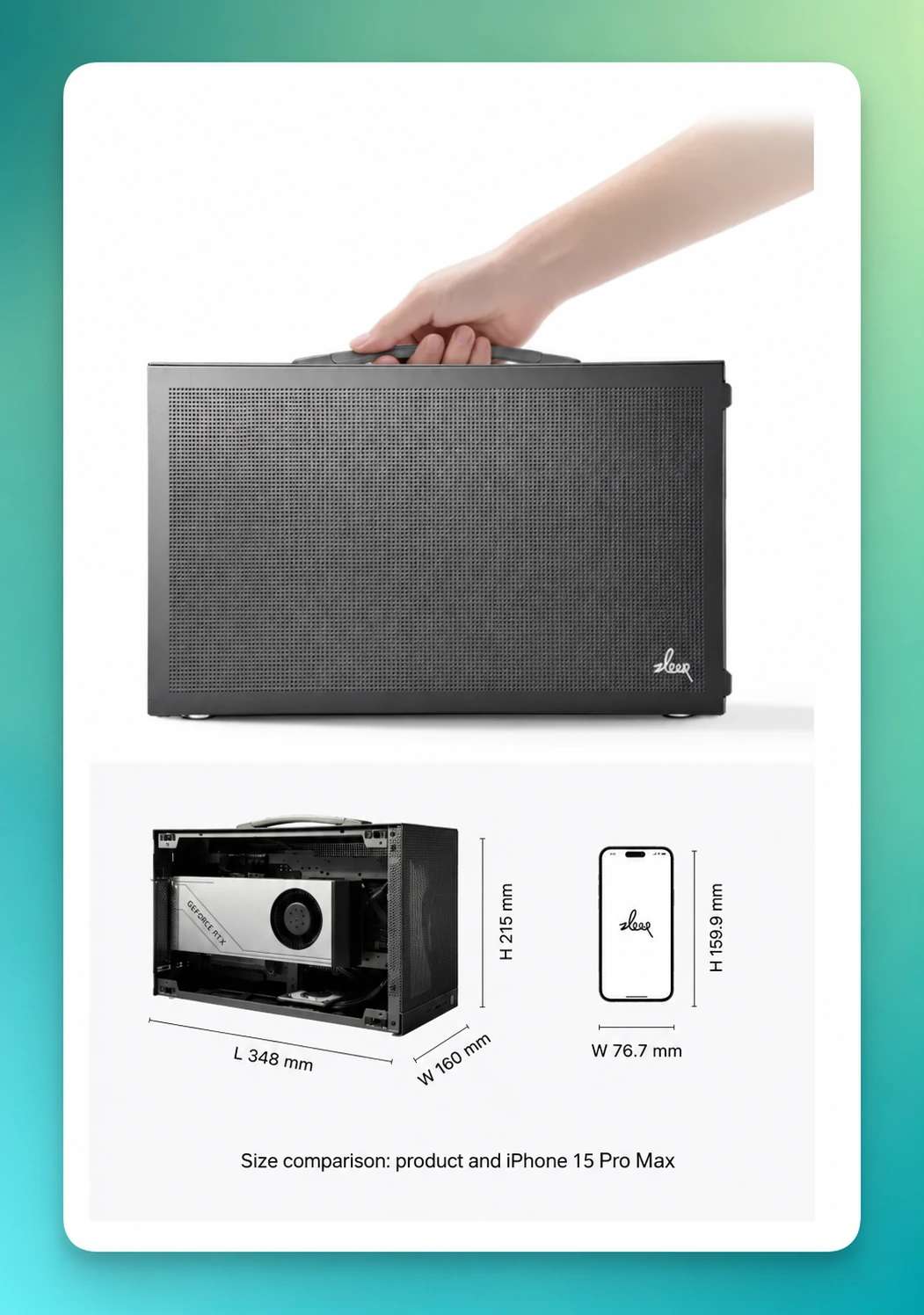
The Zleap agent appliance is his second AI product. Following the success of 302.AI [1], he introduced Zleap-D1: a one-time purchase of RMB 68,000, running small local models and capable of operating entirely offline.
It has one central task: automatically collect internal enterprise information and periodically generate an unfiltered report for the CEO.
This seemingly countercurrent design reflects a close understanding of its target audience: Chinese business leaders.
Jomy found that executives are unwilling to upload their most sensitive operating data to a new SaaS company's servers. Private deployment is a firm requirement. A physical appliance that can operate offline directly addresses that trust issue.
His insight also comes from an unusual background. He is an entrepreneur with nearly ten years in advertising and e-commerce, rather than a conventional AI specialist. He experienced the organizational difficulties of growing from a handful of people to nearly a hundred, and the feeling that a larger company makes the truth harder to reach.
Zleap's first product is therefore something he built for himself. As both developer and user, he knows that serving these businesses requires addressing executives' need for security and control.
Quick questions
Koji: Your age?
Jomy: 34.
Koji: University?
Jomy: Central South University, though I did not graduate.
Koji: MBTI and zodiac sign?
Jomy: INTJ, Libra.
Koji: Your current company and product in one sentence?
Jomy: The Zleap agent appliance.
Koji: Funding?
Jomy: Zleap is preparing for a Series A.
Koji: Revenue and profit?
Jomy: The product has not gone on sale yet, but there are already many interested customers.
Koji: Team size?
Jomy: Nearly a hundred including 302.
Koji: What did you do before this?
Jomy: Advertising and e-commerce.
Positioning
Koji: Where did the idea for an agent appliance come from?
Jomy: I have worked on 302.AI for almost two years and met many enterprise customers. They face difficulties adopting AI: technical problems, poor results, or excessive costs.
I kept thinking we could integrate hardware, compute, software, and agents into a complete solution delivered ready to use.
But what kind of agent should we build?
Early this year I spoke with Mr. Zheng, an experienced leader in high-tech manufacturing. His company has around 1,000 people nationwide, and management is difficult. He asked whether AI could help him manage the company. I realized this was a market with serious problems, strong purchasing power, and few products addressing it. That started Zleap.
I have also been an entrepreneur for almost ten years. As the company grew from two or three people, I experienced organizational change and the feeling that the bigger the company becomes, the further you are from the truth. Many business-owner friends share the problem.
Our first appliance therefore focuses on automatically collecting frontline information and generating clear reports to support management and decisions.

Koji: Who is the target user?
Jomy: CEOs and management teams. If you struggle with information transparency, you are a target user.
Koji: Why this group?
Jomy: Three reasons:
- Improving leaders' effectiveness produces the greatest company-wide benefit. Better direction helps the whole company develop.
- Leaders who experience AI's benefits can promote adoption throughout the business from the top down.
- They have purchasing power, making this commercially attractive.
Koji: What is the price?
Jomy: RMB 68,000 for the hardware and software as a one-time purchase. The first 1,000 customers who pay a reservation deposit can deduct RMB 10,000 from their final payment.
Koji: How did you set that price? Intuition or a detailed cost-and-value model?
Jomy: Both. The range reflects costs and development spending, but 68,000 was chosen partly because it is an auspicious number.
For a business, it is roughly the annual total cost of an employee earning RMB 5,000 a month. We believe Zleap delivers considerably more value.
Koji: A one-time purchase runs against today's cloud and SaaS model. You must continually acquire customers. What about growth limits and cash flow? Will model or feature upgrades generate recurring revenue?
Jomy: First, the market is large enough that its ceiling is not an immediate concern.
Second, this is our first product. We are planning appliances for developers, finance, and other roles, expanding the market further.
Third, we will provide customized enterprise features integrated into the appliance, reducing customers' development costs. That will create continuing demand.
Future updates to built-in models and general features will be free.
Background
Koji: You mentioned not graduating. What led to that?
Jomy: I began building a business at university, during the early app era, shortly after Apple's App Store launched. Many apps I wanted did not exist, so I taught myself programming and built them.
I have always been very focused and became deeply absorbed. My major was materials chemistry, unrelated to programming, and I lost interest in classes. It was less a deliberate decision than how events unfolded.
Koji: What did your advertising and e-commerce work involve?
Jomy: Mobile advertising and cross-border e-commerce, both serving overseas markets. I would rather focus on AI now than discuss previous successes.
Product
Koji: Why choose integrated hardware and software?
Jomy: Data security and compute costs.
Executives do not want confidential company information stored with a new SaaS vendor, so private deployment is essential for many businesses.
Our agents also consume substantial compute. In larger companies, they may run around the clock. With an appliance, you pay for electricity without additional token charges.
Koji: Is there a marketing consideration? Does a tangible machine feel more valuable and make purchasing easier?
Jomy: Somewhat, though it is not the main reason. Chinese business owners often trust a physical machine they can see and touch more readily than SaaS.
Koji: Other appliances cost hundreds of thousands or even millions of yuan. How do you reach RMB 68,000?
Jomy: I wanted an affordable product for small and medium businesses from the outset. We deliberately chose a compact, single-GPU appliance.
GPUs are the main hardware cost. Fewer GPUs reduce that cost. Most of our added value is in the software solution.
Koji: What can Zleap do, and what do customers value most?
Jomy: At this stage, information collection and processing.
Collection must be unobtrusive and require no development work. Processing must extract what matters without hallucinations. Few products do both well.
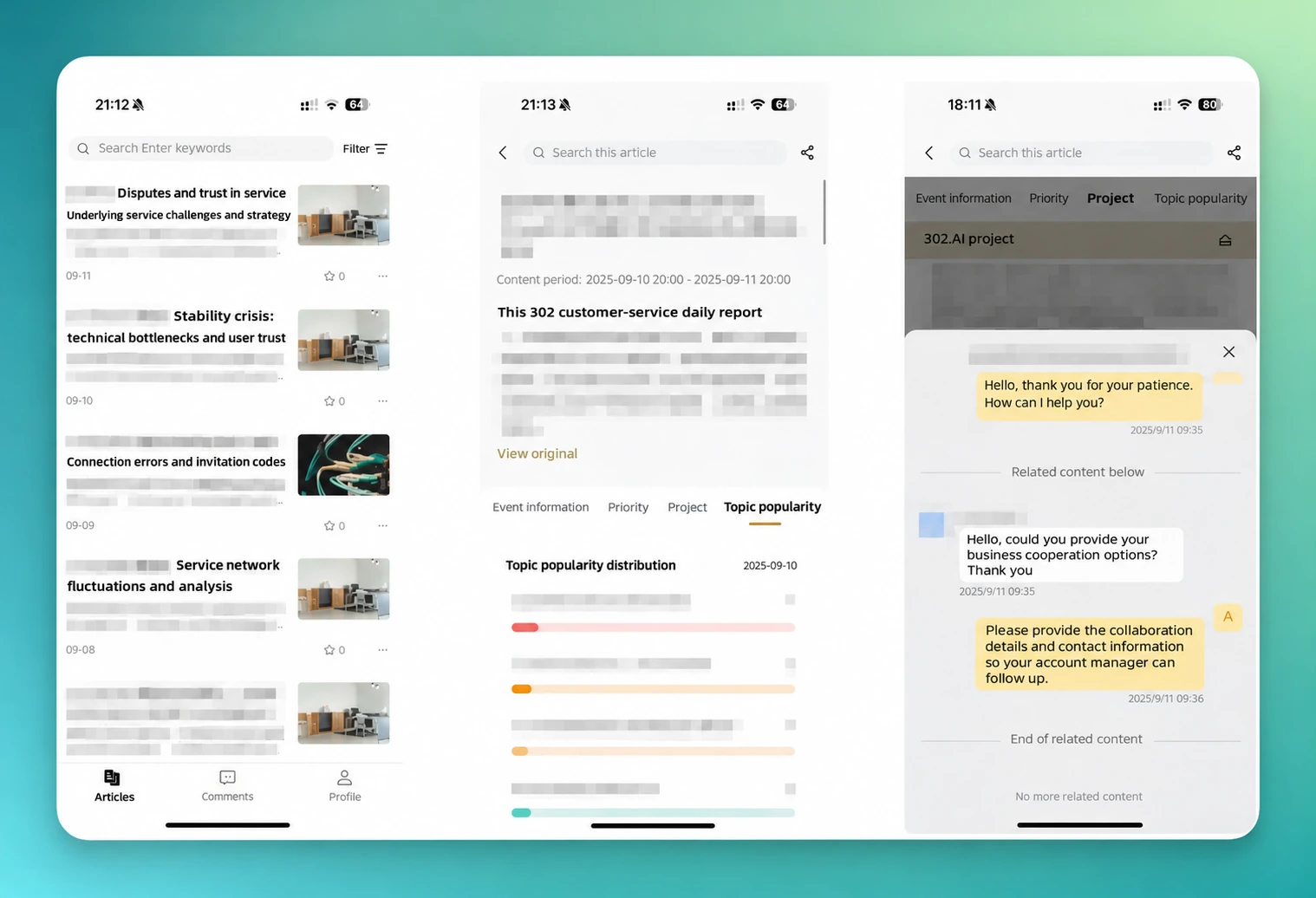
The Zleap app can show original customer service conversations.
Koji: Has it uncovered a particularly surprising issue or opportunity?
Jomy: Before public sales, we served two internal customers: 302 and our angel investor Mr. Zheng's company. One is an internet technology business with around a hundred people; the other is a high-tech manufacturer with around a thousand.
Speaking about 302, on my first day using it I noticed frequent inappropriate support replies. That exposed insufficient technical training. We addressed it, and satisfaction with support responses has improved substantially.
I also search for customers requesting invoices through 302's support channels. Whatever the amount, those requests indicate business use. Paying closer attention to them has helped us develop promising major customers and produce actual growth.
Koji: Your phrase “direct access to the truth, without filters” could sound like surveillance to employees. How do you handle cultural resistance?
Jomy: Our collection channels comply with platform rules. For example, Feishu bots can collect group-chat information, but not private messages. These platforms have already considered privacy when defining permissions.
The product is built for business leaders, and I believe each leader has a way to implement it.
From an employee's perspective, it collects work-related information. People doing their jobs properly need not worry, and it can make frontline contributions more visible.
Koji: Deploying tools also distributes power. This sounds distinctly shaped by Chinese management. What three traits would describe your typical customer?
Jomy: Astute, hardworking, and focused on control.
Koji: How does Zleap serve those traits, particularly where Western management software may overlook them?
Jomy: Astute means you must deliver practical help. Empty claims do not work. Zleap aims to make upward reporting genuinely useful.
Hardworking means many Chinese business owners involve themselves personally in many matters and are exhausted. We want AI to handle complicated information so they can focus on more important work.
Control means they want a clear understanding of what happens. China's competitive market creates insecurity. By connecting internal information channels and showing frontline events daily, Zleap can help leaders feel more informed and secure.
Technology
Koji: How do local and cloud models divide the work?
Jomy: We do not use cloud models. Everything runs locally. You can copy data in with a USB drive and operate entirely offline.
Koji: Are small models sufficient? What is different about developing with them?
Jomy: Last year they were not sufficient, but this year is different. Recent open releases such as Qwen3-2507 perform very well.
Even good small models are less capable than large ones, so development must differ. Large-model applications follow “more intelligence, less structure.” Small models require the reverse: clear task decomposition, fewer open-ended decisions, and more explicit execution. Prompt engineering is different too.
I hope Zleap encourages more practical development with small models.
Koji: Which enterprise sources do you support?
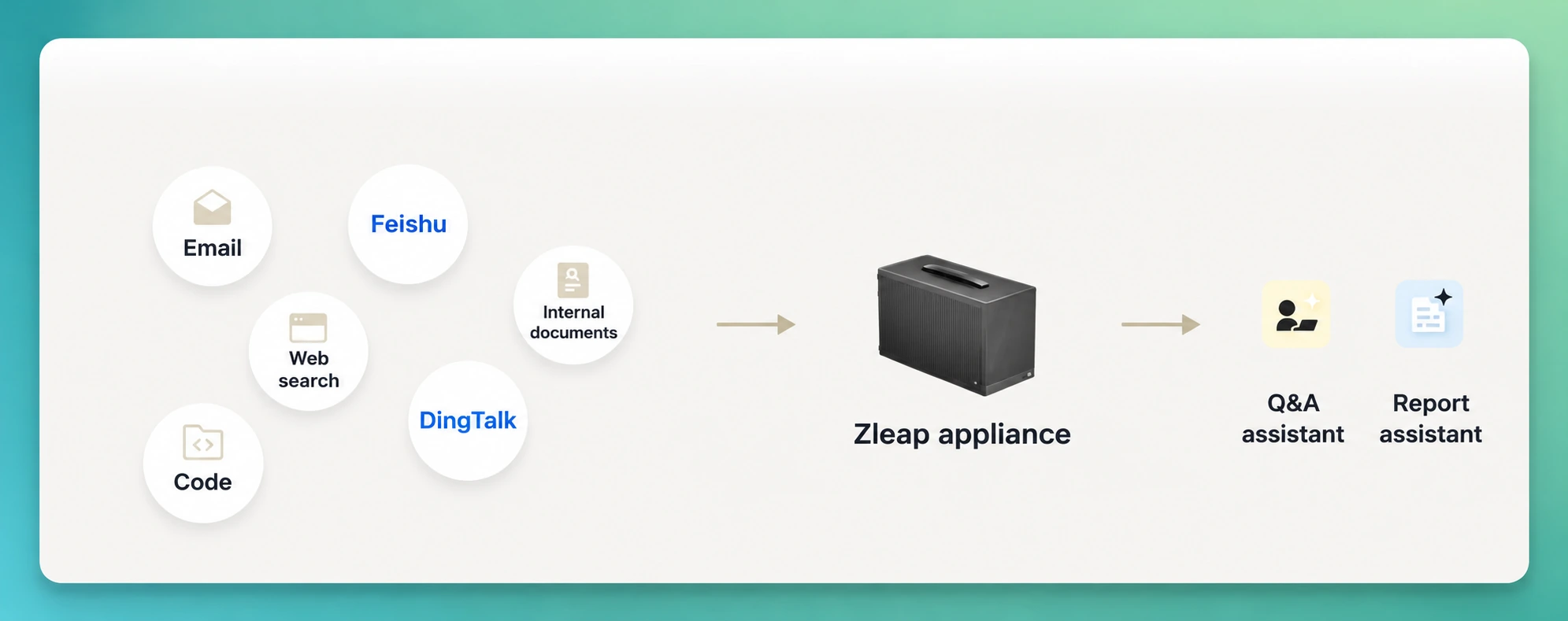
Jomy: Feishu, DingTalk, documents, links, and reports submitted through the Zleap app. We plan weekly additions and support customized internal integrations.
Koji: Much of what CEOs need may be in WeChat. Can you connect that data?
Jomy: We will not automatically collect WeChat information in violation of its privacy policies. If users can export data, however, they can manually import text or screenshots into the appliance.
Koji: How does the memory system work?
Jomy: It is an entirely in-house data-cleaning, information-extraction, and RAG system. A single-GPU appliance cannot support extremely long context, so retrieval is necessary.
Poor RAG results often come from dirty data. Our approach resembles data preparation for model training: an agent intelligently processes and annotates information first, improving subsequent retrieval.
Koji: You described an in-house framework superior to GraphRAG. For messy meeting notes, how does it differ from open-source solutions such as LlamaIndex?
Jomy: Our approach is distinctive in both its principles and engineering.
GraphRAG uses an LLM to extract a relationship graph, essentially entities and relationships. We consider that structure one-dimensional.
Zleap RAG extracts features across multiple dimensions. We also establish entity relationships at retrieval time rather than when importing data. This resembles multidimensional human memory and association. We intend to publish a paper explaining it in detail when time permits.
On the engineering side, many open-source RAG projects are developed for research or exploration rather than enterprise deployment. Real deployments encounter numerous issues and high implementation costs. Our appliance is ready to use after purchase and power-on, at a relatively accessible price.
For the same disorganized meeting notes, we can extract information more accurately and comprehensively with fewer hallucinations than open-source solutions or leading large models. A large model may generate meeting minutes in one conversation; our agent may run 1,000 times behind the scenes for one set of minutes.
Koji: What do those 1,000 runs mean? Query expansion? Would latency and compute costs explode?
Jomy: Not query expansion. Most of the work is cleaning and analyzing data as it arrives.
There is latency: generating a report takes tens of minutes. But collection continues 24/7, and the LLM begins processing during ingestion. The computation is spread over time, reducing the perceived delay.
Heavy compute use is already common in the agent era. For an appliance, it is an advantage because the additional cost is electricity rather than tokens.
Koji: What dimensions do you extract—entities, semantics, sentiment, time, contextual position?
Jomy: Different information types require different dimensions, based on substantial know-how. We also support custom dimensions added automatically around a user's priorities.
Koji: Have you conducted standardized benchmarks on meeting minutes, answer accuracy, or hallucinations?
Jomy: Current benchmarks are often too basic or academic, and cannot evaluate many of our features. Traceability is an important part of avoiding hallucinations: users can drill through the interface to original information, which is hard to assess automatically.
We have internal evaluation datasets and may publish benchmarks better reflecting enterprise needs.
Koji: You study models and RAG deeply, despite not having a computer science degree. How did you build that knowledge?
Jomy: In the AI era, a strong desire to learn matters more than formal background. More than ten years ago, I learned programming from physical books and Stack Overflow. AI search, question answering, and translation now make learning much more efficient.
Competition
Koji: Who are your competitors?
Jomy: We do not see direct competitors. We hope to create a new agent appliance market and encourage more AI companies to build practical products.
Koji: What about indirect competition—other ways customers could obtain similar value?
Jomy: SaaS products may compete, including Feishu's and DingTalk's built-in AI. But they do not support as many data sources as we do, and cannot provide the same private deployment.
Koji: How large is the market?
Jomy: I believe at least 100 times the AI appliance market.
Koji: How large is that market today?
Jomy: Estimates range into tens or hundreds of billions of yuan. Conservatively, I would say US$1 billion.
Entrepreneurship
Koji: 302.AI has done well, but Zleap is a different direction. Why start again rather than focus entirely on 302?
Jomy: That is a misunderstanding. I have not abandoned 302; I split my time evenly. Just as Manus has not abandoned Monica, one product can be focused and specialized while another offers broad coverage.
They also reinforce each other. 302 serves enterprise customers and can bring them to Zleap. Zleap can use applications developed at 302 to expand its software ecosystem.
Koji: Why now? What changed technically or commercially?
Jomy: I started Zleap early this year because of progress in small models.
DeepSeek's R1 paper showed reinforcement learning bringing small models toward previous large-model performance. That impressed me. Test-time scaling makes large models smarter, but also makes small models practically usable.
I wondered whether one GPU could meet 90% of enterprise needs.
Many papers in 2025 show specialized small models outperforming closed general models in specific domains. In information processing, we have also found small models plus agents can substantially outperform large models.
Koji: Why are you particularly suited to build it?
Jomy: The first appliance is not intended for individual developers or tiny teams. If a company is small, you can simply ask everyone what they are doing. The need arises at a certain scale.
AI founders often fall into two groups: very young, small teams or established large companies; many focus on consumers or models. There are fewer business owners in my position.
I have the need, understand CEOs, and understand AI. I am building the first product for myself as both developer and user.
AI
Koji: Which three AI products do you use most, and why?
Jomy: This is not an advertisement, but I really only use 302 products. They cover my needs. If I need something else, I can ask the technical team to build it and then open-source it.
Koji: Two examples?
Jomy: I often use the desktop client and AI academic paper search.
The client is a chat application integrating many models. We have refined many details. Open-source clients without backends can lack functions; 302 has a broad range of APIs, making integration more convenient.
The paper search finds research, translates it while preserving the original layout, and supports questions about it. I generally read the Chinese and English versions side by side with AI Q&A.
Koji: What is the biggest technical or product shift you expect over the next three years? Opportunity or threat for Zleap?
Jomy: After test-time scaling, no new paradigm has yet emerged, so large-model progress may slow. Small models still have untapped potential. They will improve in specialized fields, and tools will turn them into agents that can bring AI into many industries.
The next three years should be the agent era, and a second period in which AI changes the world.
For us, this is a major opportunity. Affordable, privately deployable agents will become essential for many businesses.
Koji: One piece of advice for CEOs feeling anxious about AI?
Jomy: Companies using AI will outcompete those that do not. Business leaders should start using it themselves.
For more about Zleap-D1, see Introducing the Zleap-D1 Agent Appliance for AI-Driven Management.

Reference
[1] 302.AI: http://302.ai/