
From Transformer to Transformation: Challenges and Paths for Enterprise AI
Seven challenges in enterprise AI use and organizational relationships, and two paths forward through context infrastructure and organizational integration.
Last Saturday, we attended an FDE event at the Alibaba Center in Guangzhou and spoke with people working on, or interested in, enterprise AI deployment.
Our main conclusions:
- Enterprise AI adoption needs organizational infrastructure in addition to model capability.
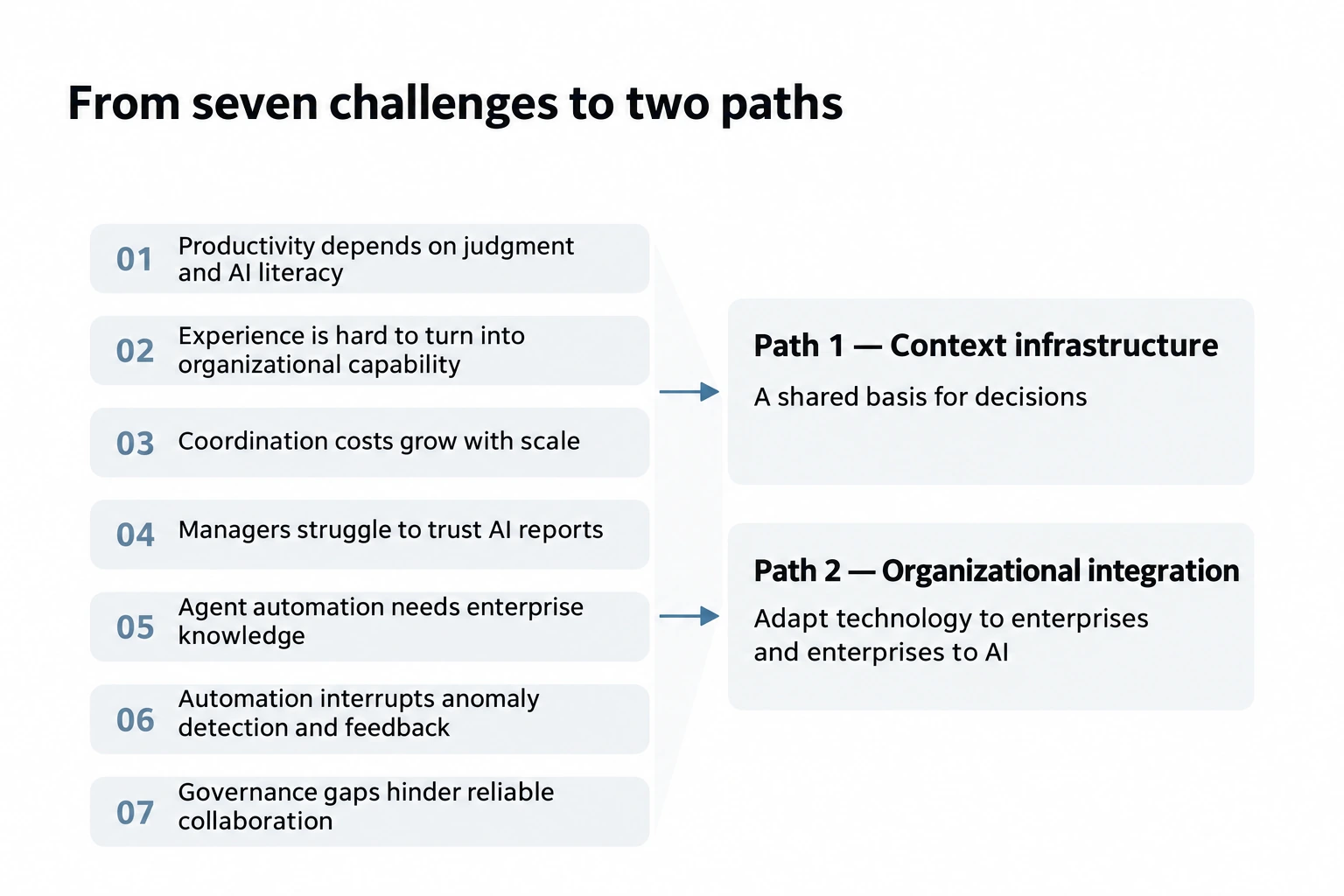
- Seven problems arise across AI use and organizational relationships.
- Two paths forward are context infrastructure, as a decision foundation, and organizational integration.
01 | Enterprise AI Needs Organizational Infrastructure
Consider the data. Investment in enterprise AI has continued to grow.
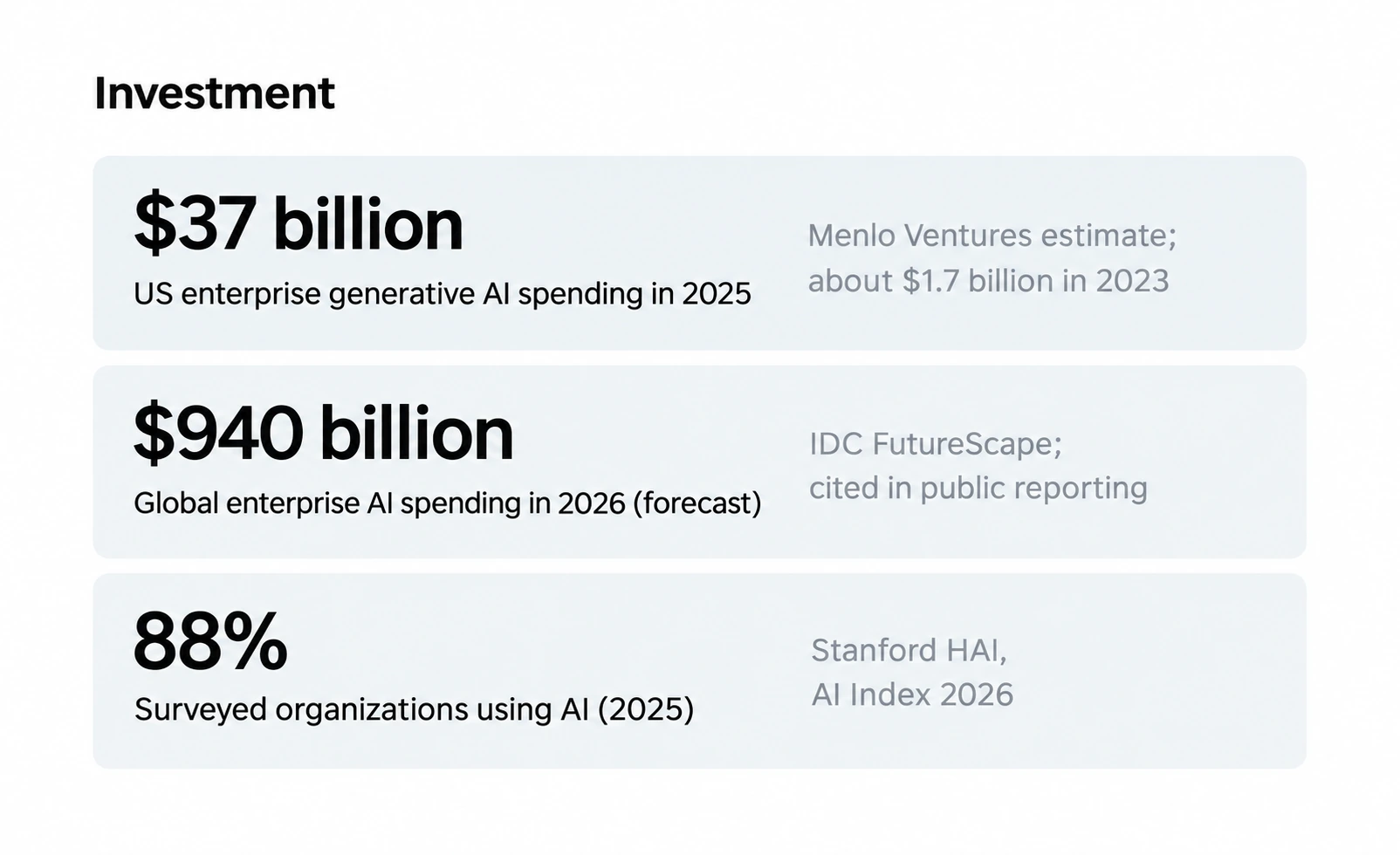
Investment figures: Menlo Ventures, IDC and Stanford HAI.
Menlo Ventures estimates that US enterprise generative AI spending reached $37 billion in 2025, more than three times the previous year's $11.5 billion, compared with $1.7 billion in 2023.
IDC projects $940 billion in global enterprise AI spending in 2026. Stanford HAI's 2026 AI Index reports that 88% of surveyed organizations used AI in 2025.
Yet these investments have not consistently translated into performance gains.
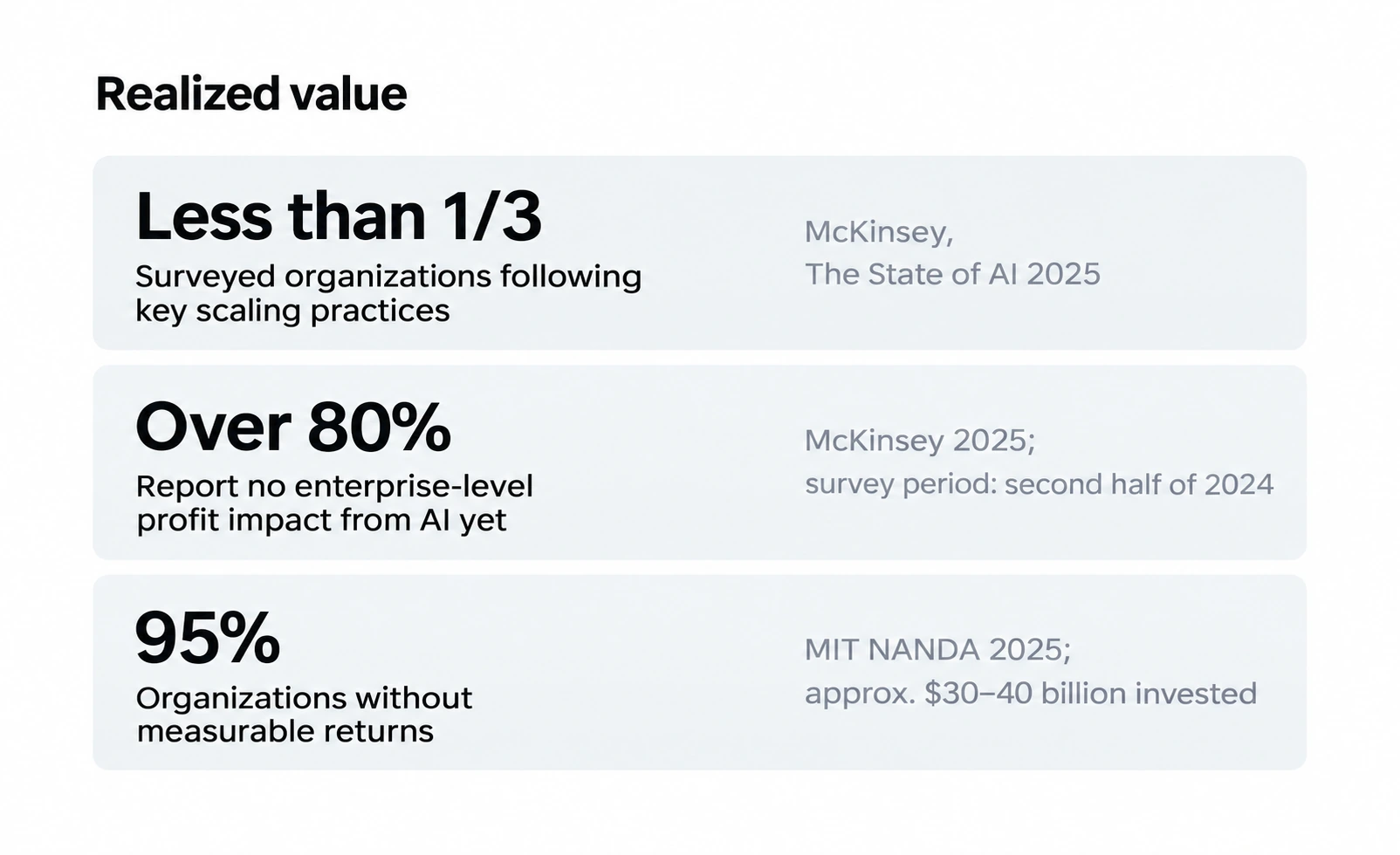
Outcome figures: McKinsey and MIT NANDA.
McKinsey's 2025 State of AI survey found that fewer than one-third followed major scaling best practices, and more than 80% reported no visible enterprise-level EBIT impact from AI.
MIT NANDA's report was more direct: despite $30–40 billion of enterprise AI investment, 95% of organizations reported no clear returns.
Adoption is broad; depth lags behind.
Why? Companies have connected model APIs, created specialist agents and seen individuals improve their output.
Connecting model capability is only an initial step. Turning AI into enterprise performance also requires the organization to become more compatible with AI.
Many enterprises lack the organizational infrastructure to support this transition, making returns difficult to realize.
To explain this, we need to examine what enterprises use AI for and the problems in those uses.
02 | E.T.AI: When AI Arrives in the Enterprise
The Transformer architecture behind today's large language models originated in the 2017 paper Attention Is All You Need.
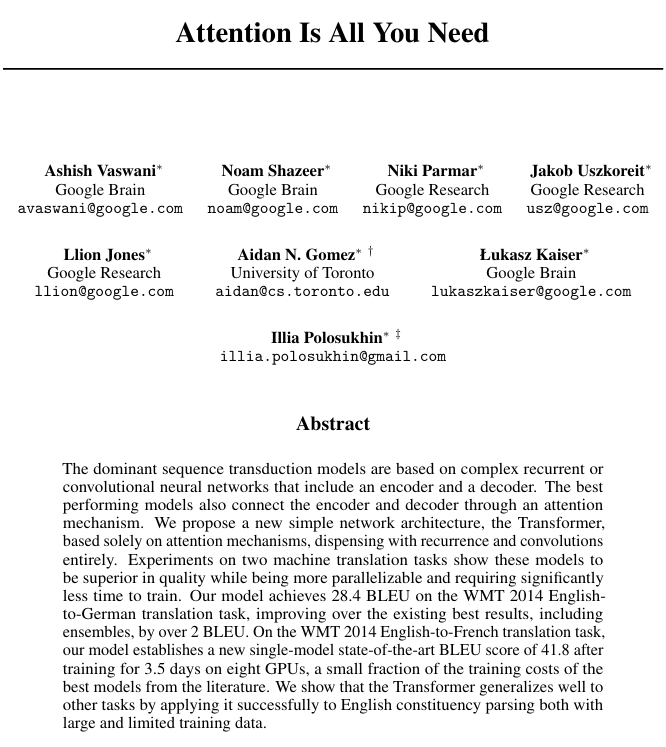
Vaswani et al., 2017, arXiv:1706.03762.
Attention calculates how strongly each token relates to others in context and distributes attention accordingly. This engineering design improves language understanding and generation, with intelligence emerging as neural networks scale.
Throughout modern economic history, major technologies—from steam engines to electricity and computers—have driven broad social transformation.

Chinese edition of The Great Transformation. Source: The Commercial Press.
Karl Polanyi's The Great Transformation (1944) describes the expansion of self-regulating markets, the disruption of traditional social orders, and the resulting upheavals and protective reactions, including the Great Depression and two world wars.
An important point is that technology alone does not determine transformation. Markets, society and governments interact to shape it.
We cannot predict whether AI's social impact will match that of steam power. But Transformer-based AI will substantially transform enterprise structures and operations.
We call this E.T.AI: Enterprise Transformation with AI.

Source: Wikipedia and Universal Pictures.
The name pays tribute to Spielberg's E.T. the Extra-Terrestrial and emphasizes the encounter between human employees and digital employees.
Providing organizational infrastructure for these two kinds of participants is central to enterprise AI transformation.
03 | Forms and Problems of Enterprise AI Adoption
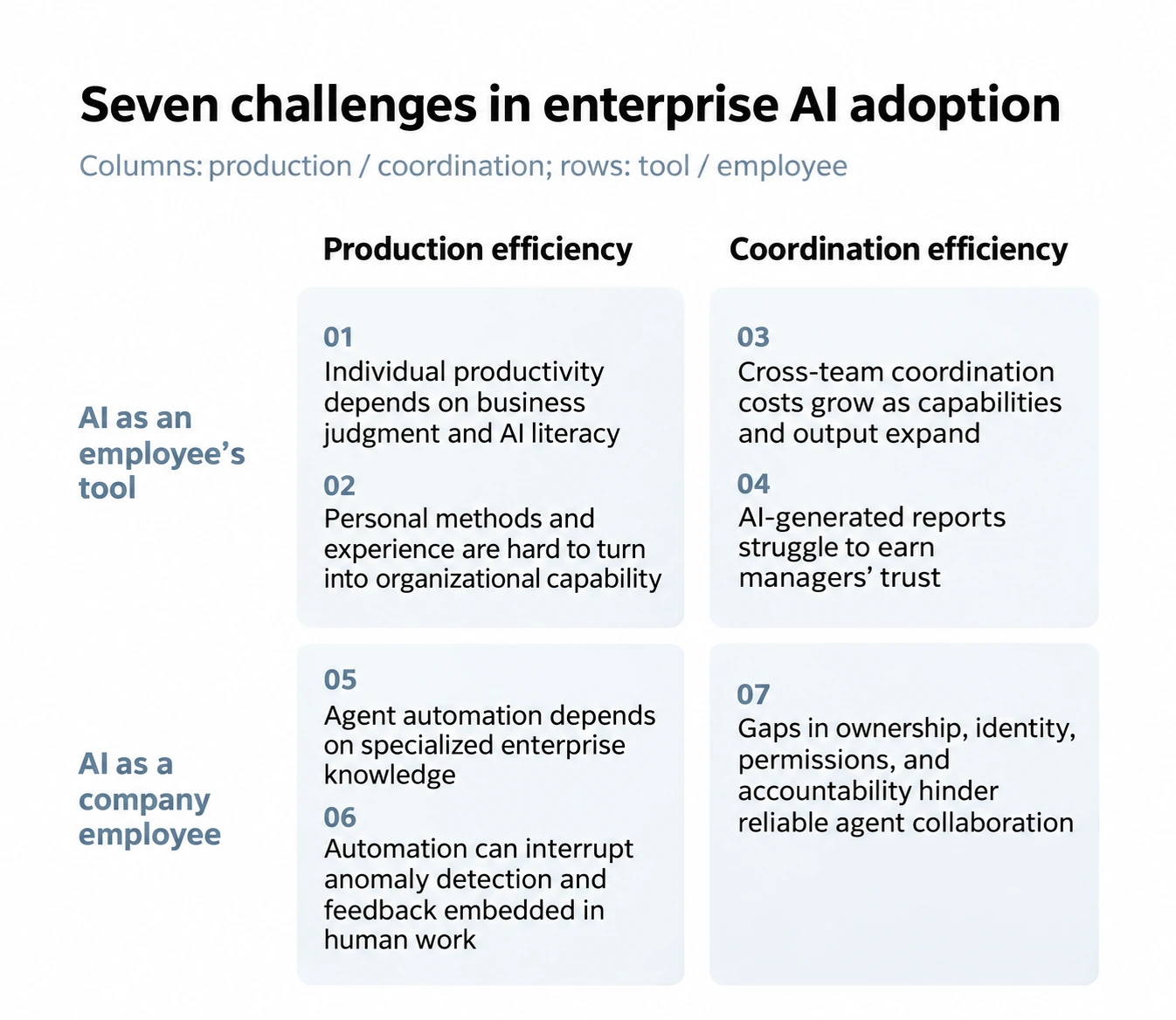
We consider two dimensions: AI's use in production or coordination, and its organizational role as an employee's tool or an enterprise's employee.
This 2×2 matrix exposes seven problems.
AI as an Employee's Tool
In production:
- Productivity depends on each person's business judgment and AI literacy, requiring individual adaptation.
- Valuable tacit knowledge remains in private conversations and devices, rather than becoming organizational capability.
In coordination:
- Greater individual capacity can make horizontal alignment more expensive as teams and their AI systems pursue different directions.
- AI accelerates reporting, but managers still need complete, current and sourced information they can trust.
AI as an Enterprise's Employee
In production:
- Agents need specialized enterprise knowledge before they can replace human work, and they usually lack it.
- Automation can remove human sensitivity to exceptions, such as customer-service staff noticing emotion or salespeople applying situational experience.
In organizational coordination:
- Without identity, permission boundaries, responsibility or clear ownership, an enterprise cannot treat an agent as one of its own members.
04 | Two Paths Emerging in the Industry
The industry is examining these problems.
MIT NANDA identifies learning as a central obstacle: most AI systems fail to retain feedback or adapt to context. Gartner similarly attributes many agentic AI failures to missing context and coordination rather than inadequate models.
Two paths emerge from current practice:
- Context infrastructure: organize scattered information and knowledge around specific tasks so AI can understand the enterprise.
- Organizational integration: once AI understands the enterprise, give it a place in organizational life and enable coordination with people.
Knowledge bases, multi-agent orchestration systems and FDE practices are all addressing parts of this work.
05 | Zleap's Approach
We aim to pursue both paths.
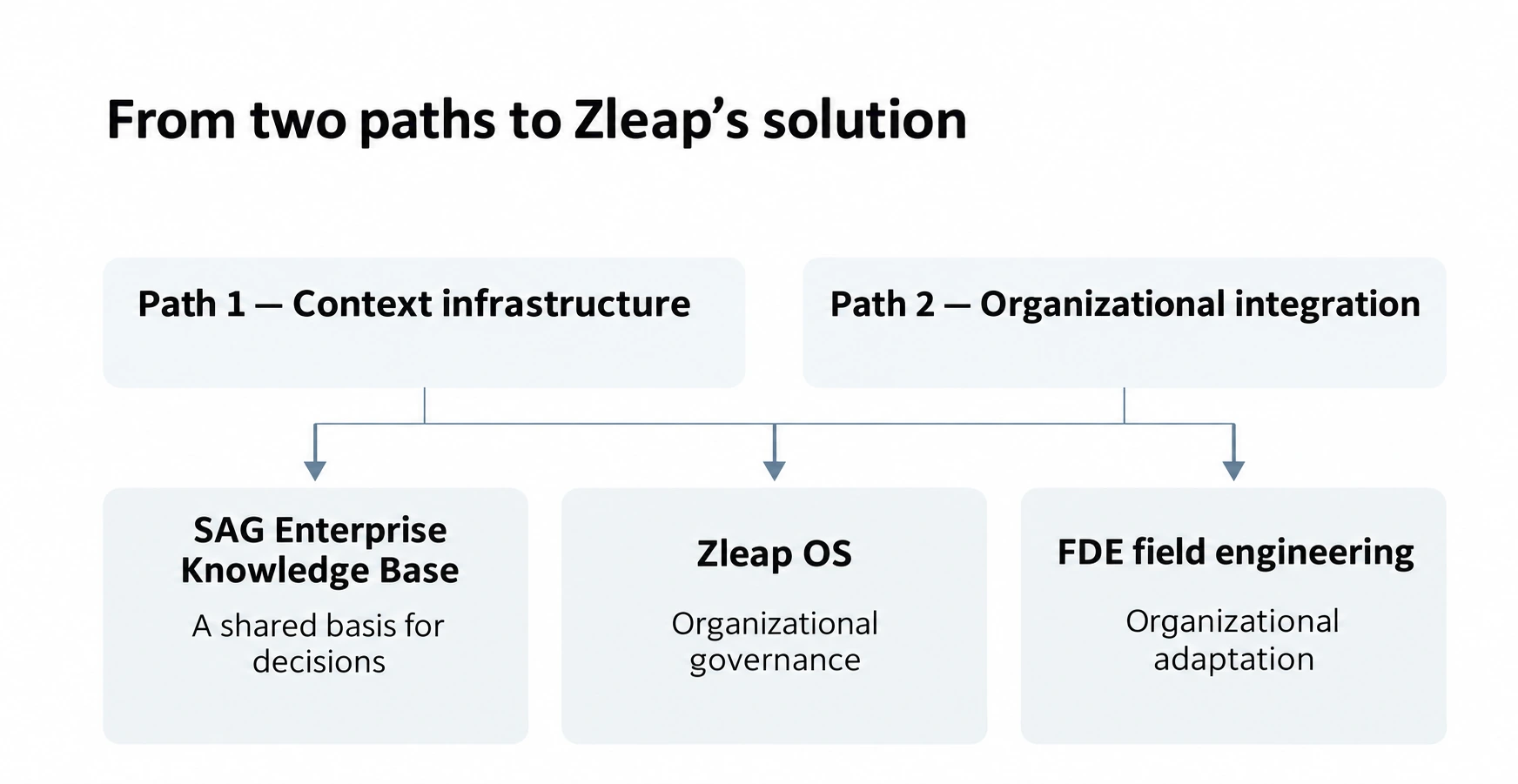
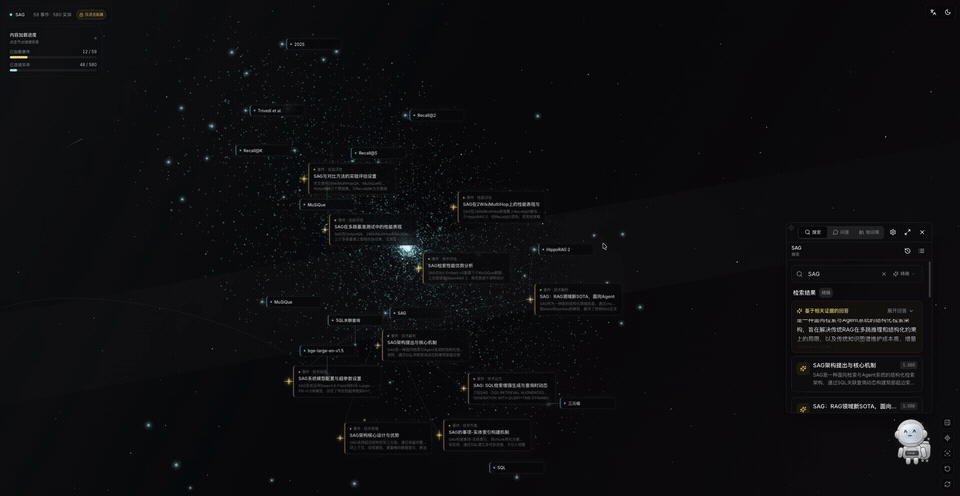
SAG organizes knowledge to support decisions.
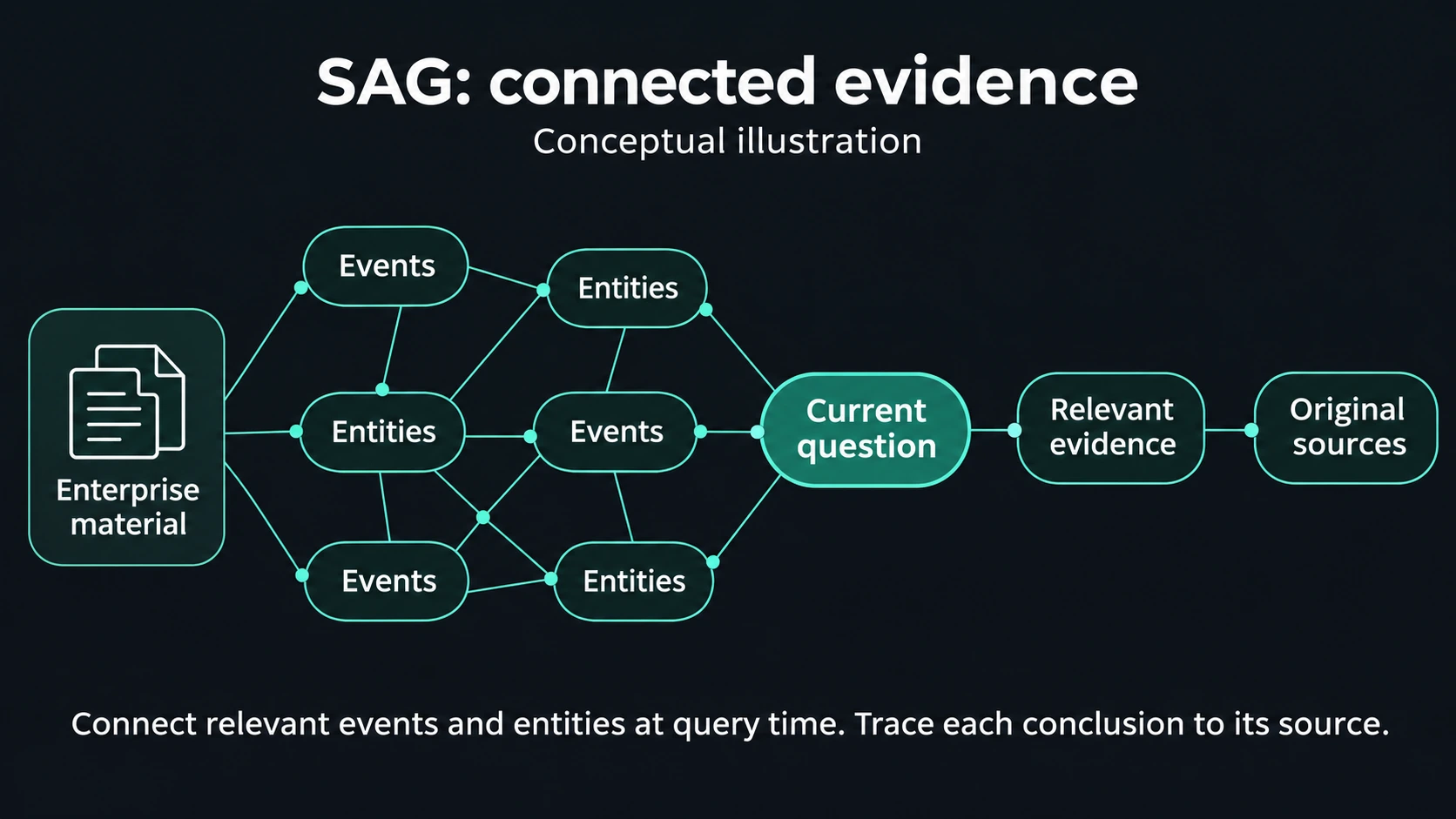
It turns enterprise material into events, extracts entities and links each event to its entities. Information becomes interconnected instead of remaining isolated chunks.
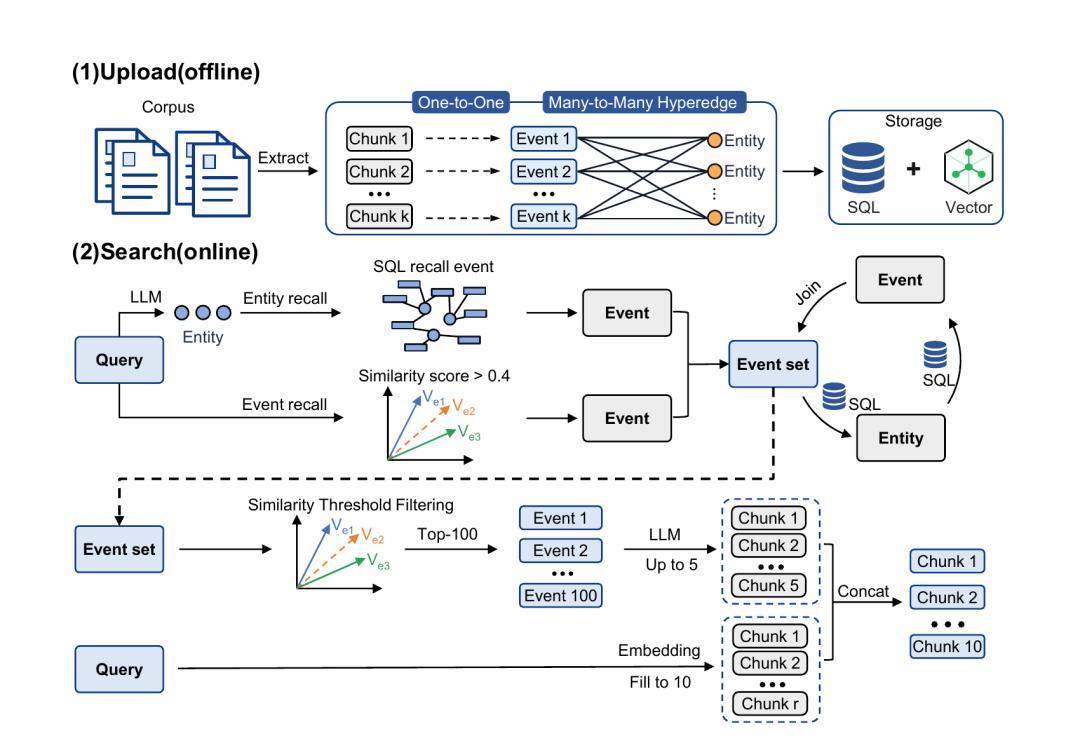
At query time, SAG dynamically connects relevant events and entities locally. It avoids the cost of building and maintaining a global graph, retrieves evidence that may be semantically dissimilar but essential to the question, and allows each conclusion to be checked against its original source.
Further reading:
After 2,000 Stars, We Turned the Knowledge Base into a Knowledge Universe
Zleap OS: Organizing Agents
Zleap OS puts governance first and organizes collaboration around projects.
Enterprise control, organizational identity, action boundaries, process accountability and open integration define governance relationships that make agents controllable organizational members.
People and agents then work through a Human–Agent Loop: people set goals and authorize action; agents operate within boundaries; exceptions return to people; people accept the results; and experience and execution records remain with the project.
FDE: Connecting Technology to the Workplace
Neither SAG nor Zleap OS deploys itself automatically.
Organizational transformation involves economic and social questions as well as technology.
Technology improves efficiency by changing divisions of labor and coordination. We therefore need standard products and services adapted to each enterprise's situation and requirements.
FDEs must understand both AI and enterprises. They connect our work to the field and return implementation experience to improve standard technology and products. More deployments build more practical capability.
Technology, products, diagnosis, implementation and consulting together form enterprise AI organizational infrastructure.
06 | This Is Only the Beginning
Watt improved the steam engine in 1765, but the first Industrial Revolution is generally considered to have continued until the mid-19th century—nearly a century in total.
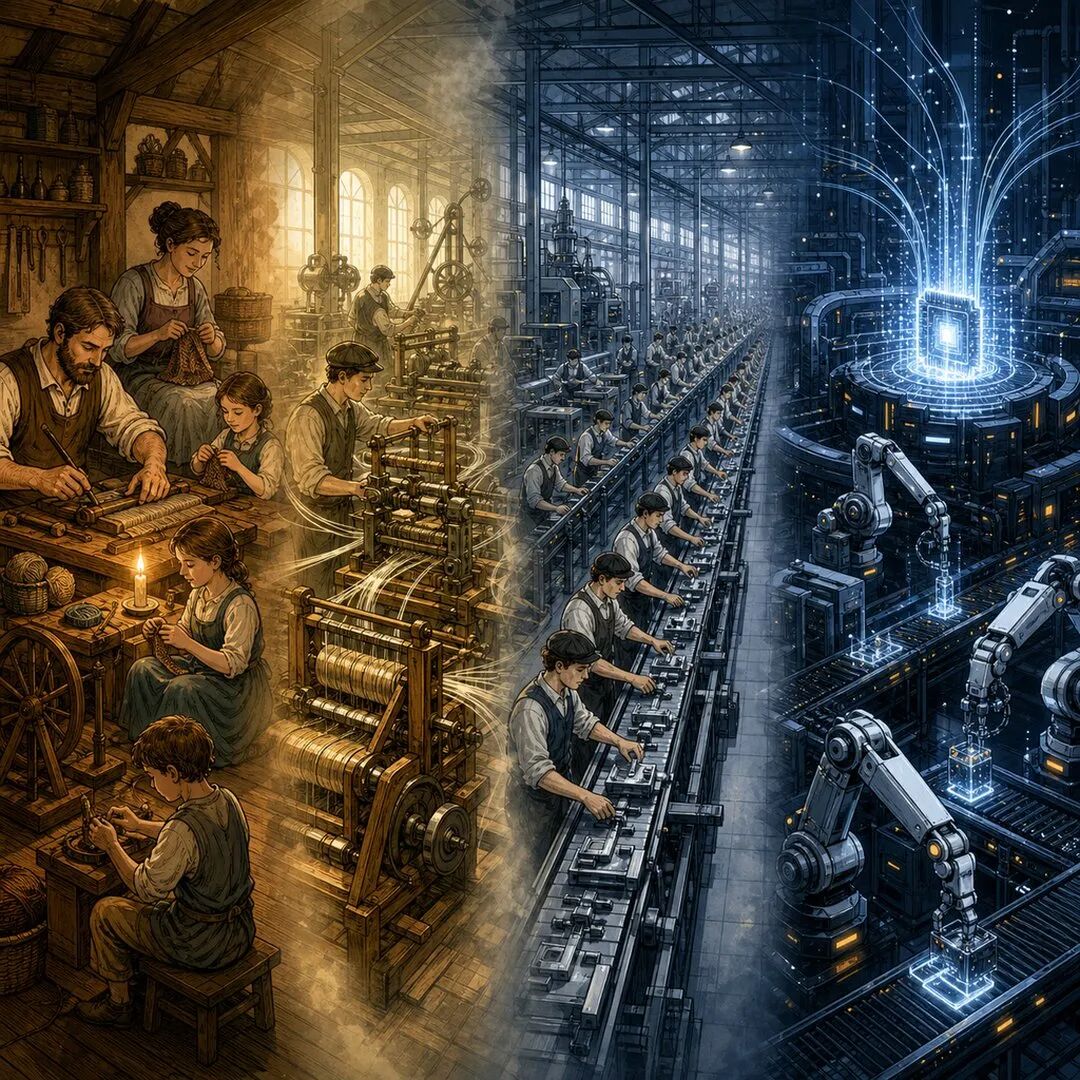
Technological change and the evolution of production organization.
The interval from invention to application has shortened considerably. Yet given AI's potential for broad transformation, we still believe we are at the beginning of major change.
Substantial infrastructure may be needed to realize its possibilities and intentionally reduce friction in employment, economics, culture and social relationships.
That is how we can aim to create a better society for our later lives and future generations.
AI may initially feel like an alien arrival—unfamiliar and threatening. Friction can accompany encounters between different forms of life or social cultures.
The more immediate question is how we coexist with it.
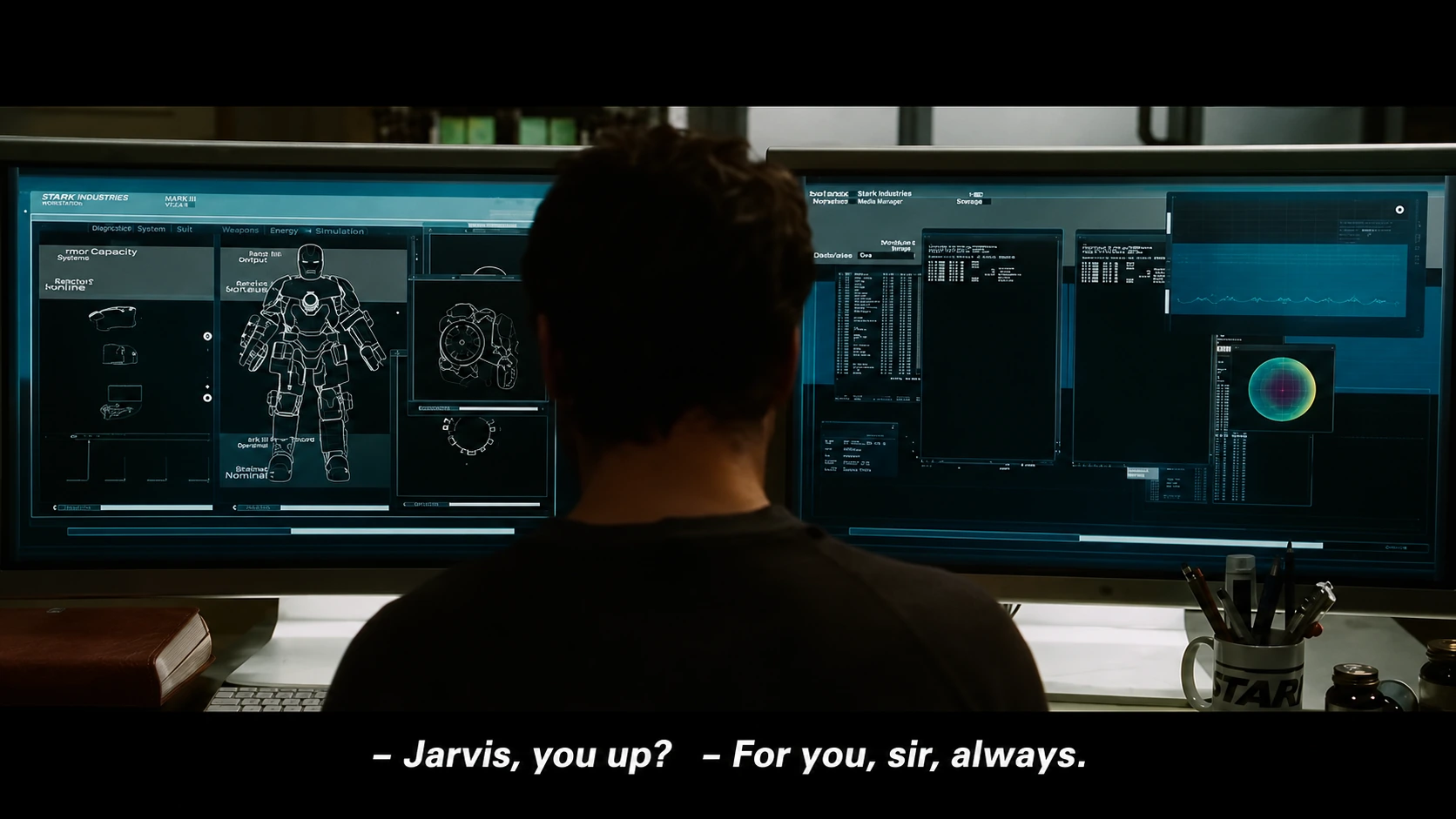
Who would not want a capable, responsive Jarvis? Source: the Iron Man films.
The famous line from E.T. is “E.T. phone home.” In our analogy, making contact requires practical infrastructure, like the telephone the family assembles for him.
AI has already arrived in enterprises. The practical questions are whether we give it a means of communication, an organizational identity, and the on-site effort needed to make the changes work.
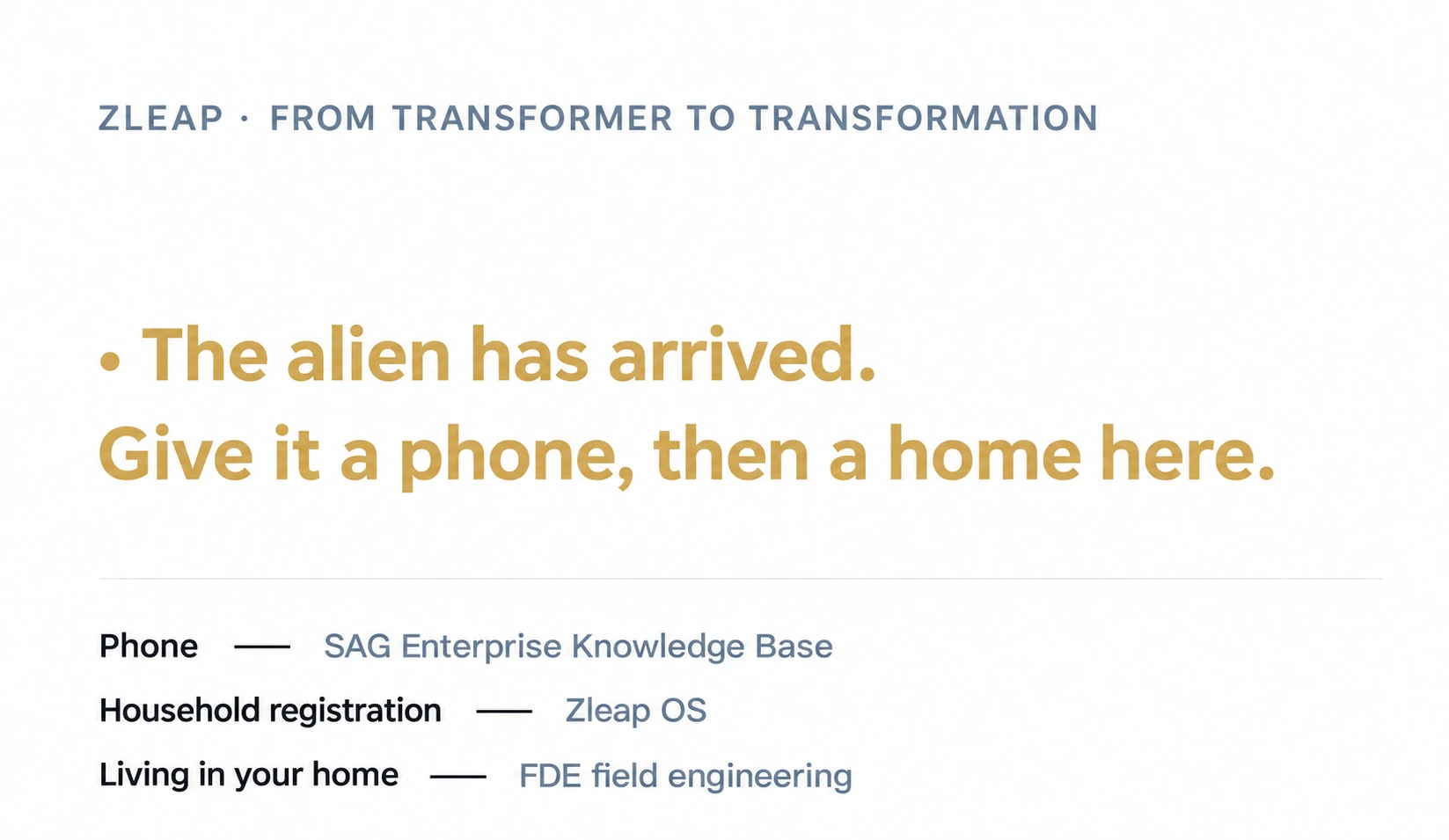
These are preliminary views, and we welcome criticism and feedback.
This month, we will examine several topics more closely:
- The seven problems behind the 2×2 matrix and how enterprises can assess themselves.
- How leading companies are addressing them.
- How to organize fragmented enterprise knowledge and data.
- How we work ourselves as a company building organizational infrastructure.
07 | Continue the Conversation
If your enterprise is adopting AI and encountering difficulties with knowledge bases or agent orchestration, add our contact and mention “Enterprise AI.”

Scan to connect on enterprise WeChat.
Sources
- Menlo Ventures, end-of-2025 enterprise generative AI survey, limited to US enterprises: spending rose from approximately $1.7 billion in 2023 to $37 billion in 2025. This is a market-size estimate, not a census.
- IDC, FutureScape forecast: approximately $940 billion in global enterprise AI spending in 2026. This figure is cited from public reporting; consult IDC's original source for the official statement.
- Stanford HAI, AI Index 2026: 88% of surveyed organizations adopted AI in 2025. AI adoption and agent deployment are different metrics; this article cites the former.
- McKinsey, The State of AI, published March 2025 with a survey period in the second half of 2024: fewer than one-third followed major scaling best practices, and over 80% reported no visible enterprise-level profit impact.
- MIT NANDA, The GenAI Divide (2025): 95% of organizations saw no measurable return on approximately $30–40 billion of enterprise investment, based on a sample of over 300 public projects and interviews with 153 leaders.
Author's note: Personal views for discussion.
Keep reading
Technology
SAG Paper V2 Is Here
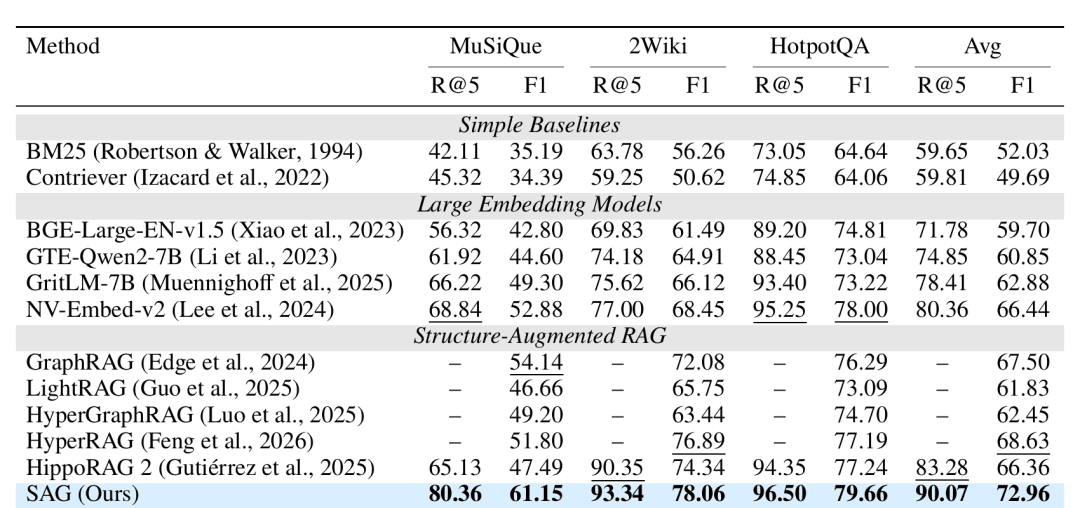
SAG V2 improves pruning and evaluates retrieval, question answering, dynamic hyperedges, entity handling and large-scale queries.
Product
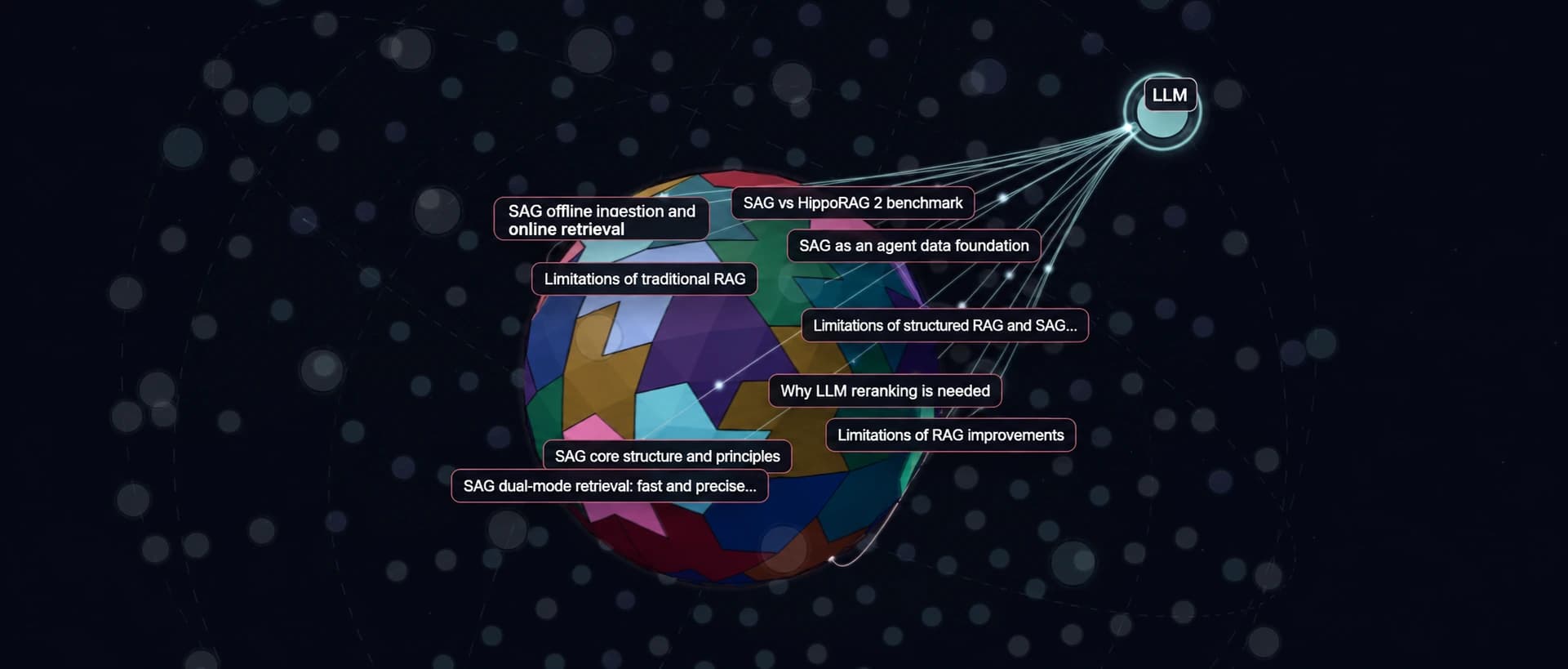
After 2,000 Stars, We Turned the Knowledge Base into a Knowledge Universe
Introducing SAG V2: an interactive knowledge explorer with list, 2D and 3D views, an independent knowledge engine, open interfaces and flexible storage.
Insights
Context Infrastructure Will Be the Next Focus in AI
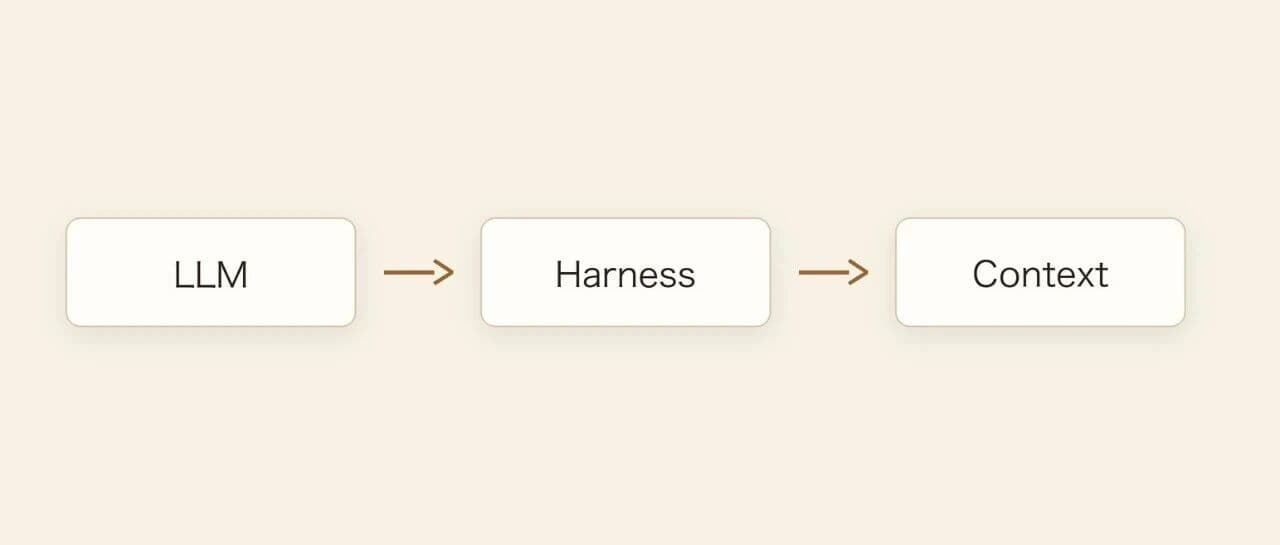
Why agents need more than models and runtimes: organizational knowledge, practical experience, and continuously updated context.