
From Tools to Employees: Trends, Principles, and Boundaries of AI Automation
Examining AI automation through capability, economics, and society, and defining authority, accountability, and collaboration between people and agents.
Key conclusions
- AI automation requires companies to reorganize their organizational relationships.
- Adopting AI requires three assessments: capability, economics, and social impact.
- Contracts can define the boundaries within which people and AI coexist in an organization.
Over the past two years, many companies have invested heavily in AI.
If the United States is going “all in AI,” China is closer to putting “AI in all.” In the former, major capital flows compete to enter AI-related industries. In the latter, AI also spreads across education, finance, social platforms, and manufacturing, with an emphasis on adoption and the redesign of organizational processes.
The investment appears to make sense. AI is now capable enough to handle many everyday tasks.
Yet a contradiction soon emerges. A working paper from MIT NANDA reports that around 95% of the organizations surveyed had yet to see attributable financial returns. Some jobs thought ready to operate without people have also produced disappointing results after people were removed.
Why does handing work to AI, seemingly the most economical choice, so often leave companies without either the expected returns or their employees?
What does replacing human work through AI automation actually involve?
01 | Two choices for automation
Let me begin with a real experience.
About a month ago, at a Build Club event, someone working in e-commerce described a need for AI customer service. His business attracted traffic through personality-led accounts, then relied on many customer service representatives in private customer channels to communicate and convert sales.
His goal was clear: use AI to replace some underperforming representatives.
People suggested many solutions, including automation scripts and simulated screen clicks.
In the middle of the discussion, someone asked: Why replace the people? Why not use AI to make existing representatives more productive, so each person can serve more customers?
He then did the arithmetic: AI deployment costs money, and the quoted prices are substantial. Running it requires further optimization. After all that work, it may cost as much as human staff, without reliably delivering better results.
This reminded me of Elon Musk.
In April 2018, when Tesla was struggling to meet production targets, Musk publicly acknowledged that he had made a mistake through excessive automation. Robots on a production line repeatedly struggled to handle fiberglass strips. Efficiency improved only after those machines were removed and people took over.
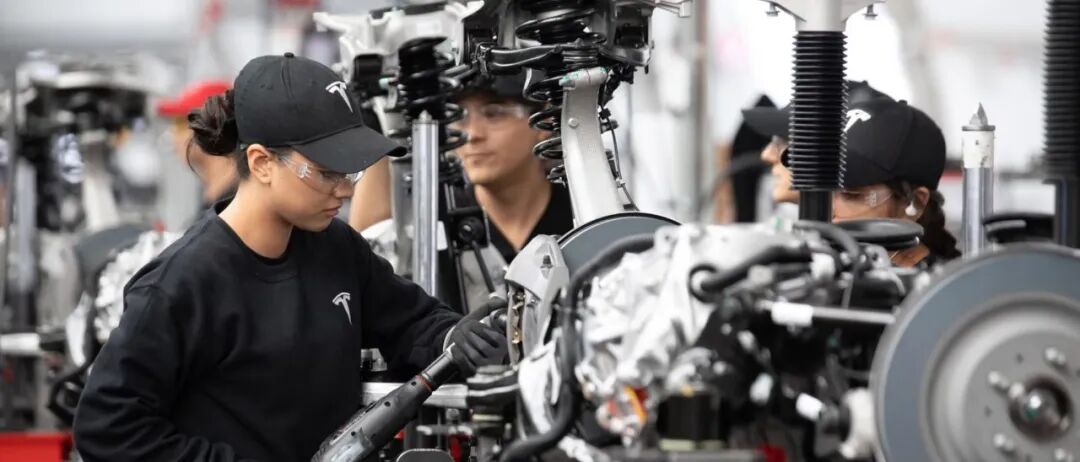
Tesla factory. Image source: Tesla website.
Even one of the world's strongest advocates for automation once removed machines from a production line and brought people back.
More complete automation is not always better. It has principles and boundaries, which follow from the nature of AI replacing human work.
02 | Automation changes organizational relationships
AI can be used in many ways inside a company.
Employees can ask it questions or give it tasks. It can also operate as an independent agent, such as a customer service agent handling customer inquiries or employees' knowledge searches.
The fundamental difference between these uses lies in AI's contractual relationship with the company.
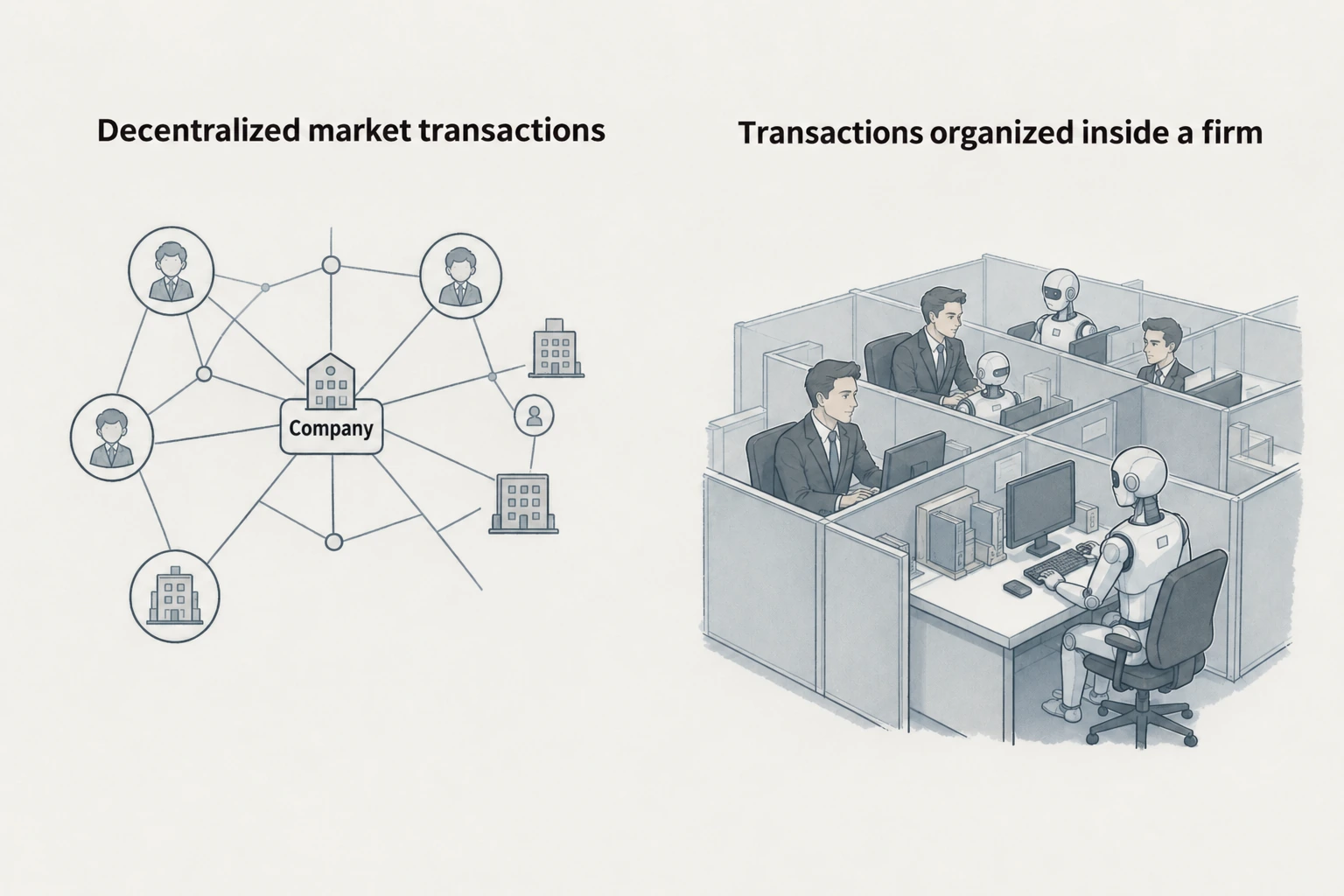
Ronald Coase, the 1991 Nobel laureate in economics and a founder of new institutional economics, directed attention to transaction contracts when explaining firms (Coase, 1937). From this perspective, a company can be understood as a collection of employment contracts between employees and owners.
Employees exchange labor for money and other value. The distinction between an employee and an external contractor is that the company replaces an external transaction contract with a longer-term employment contract containing more conditions.
Building on this, Steven Cheung (1983) argued that substitution between firms and markets is fundamentally substitution between different combinations of contracts.

We can therefore describe a continuum.
At one end, AI is an employee's tool, helping a person do their work.
At the other, AI is a company's employee, performing work itself as a member accountable to the organization.
There are many intermediate positions. Each implies a different degree of authority, responsibility, and contractual structure.
AI enters a company in different roles and establishes different organizational relationships.
1. As an employee's tool
AI is a production input that improves employees' capabilities, coordination efficiency, and organizational output.
Employees with strong AI literacy and business skills—in other words, more human capital—can gain greater productivity improvements and expand their capabilities further. They are more likely to become highly capable individual contributors.
2. As a company's employee
Adopting AI already requires a company to contract with various external suppliers: hardware, compute, and labor during deployment; model services and energy during operation; and maintenance and upgrades afterward.
As AI develops into task agents, the parties involved also change, bringing agent solution providers into those contractual relationships.
In short, enterprise AI deployment follows a continuum from tool to employee. A position on that continuum reflects how the company intends to organize its internal and external relationships, beyond differences in technical capability.
03 | How different organizational relationships work
When AI enters a company, contracts with multiple internal and external parties affect how the organization operates.
Consider a customer service agent. It can answer employees' questions or customers' questions directly. Different implementations produce different operating arrangements.
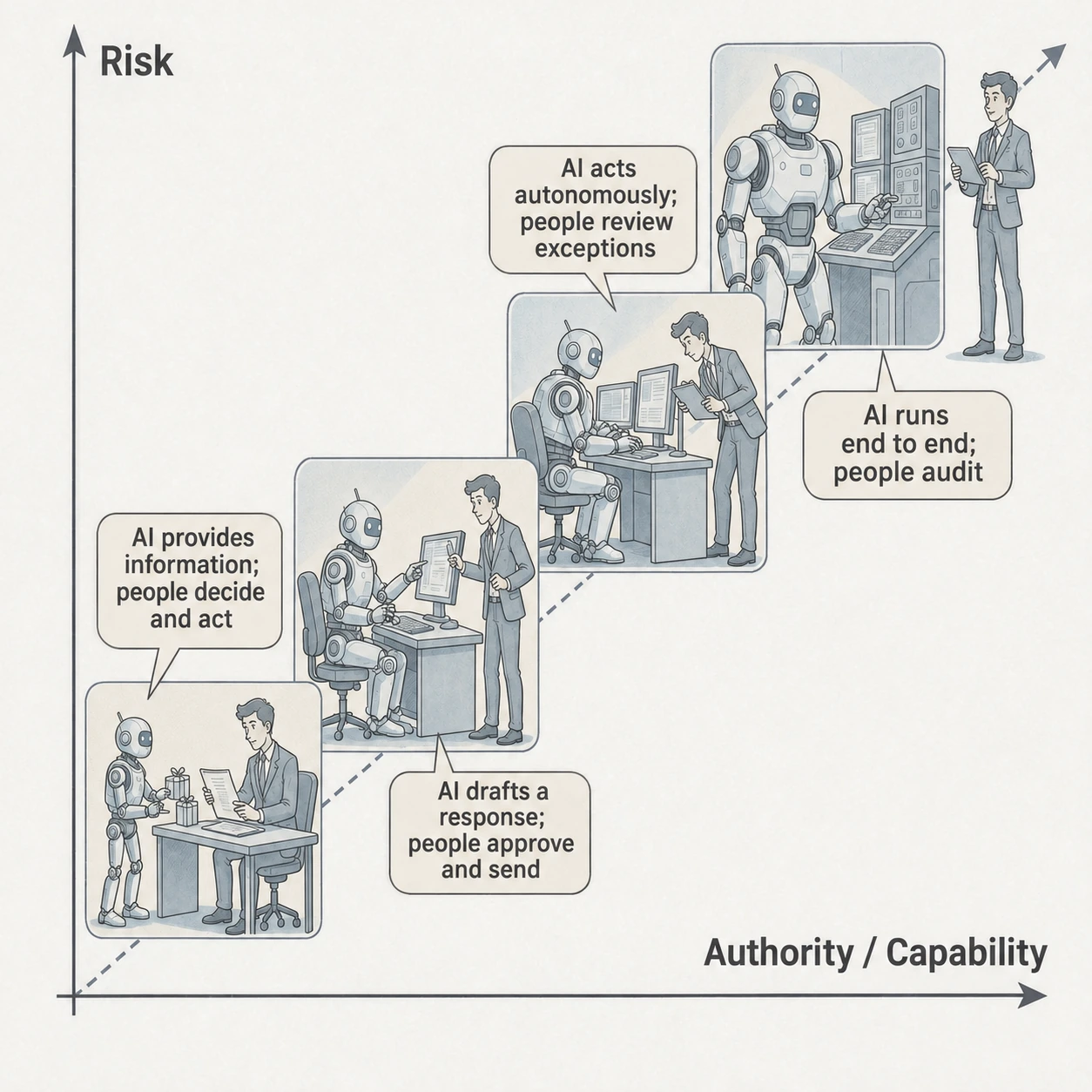
First, AI can be a basic tool. Employees ask about company policies or terms, then reply to customers themselves. AI supplies information for judgment; people ask the questions and send the replies.
Second, AI can be a more advanced tool. It generates possible answers, and a person confirms one before sending it. This saves more of the time spent composing responses.
Third, AI can receive more authority. It verifies information, creates exchange orders, and follows up according to rules. Human representatives inspect results and handle exceptions. More execution time is saved.
Fourth, with further authority, AI might operate under the after-sales team and independently handle the entire customer service workflow.
As an agent moves from tool to employee, it can do more, but it also receives more authority and creates greater risk. Incorrect replies and lost sales are obvious examples.
For this reason, some types of companies hesitate to adopt AI at all, or restrict it to specific tasks. This is an important consideration in deciding how far AI and people can substitute for one another.
04 | What kind of AI automation is appropriate?
At least three assessments are needed.
| Assessment | Core question | Better suited to AI | Greater need for people |
|---|---|---|---|
| Capability | Can the task be completed reliably? | Clear goals, verifiable results, reversible errors, standardized and repetitive work | Ambiguous goals, difficult verification, irreversible errors, customer relationships and situational understanding |
| Economics | Does it actually pay off? | Saves labor and produces results faster without increasing rework, supervision, or mistakes | High implicit value in emotional awareness, experience with exceptions, and on-site judgment |
| Social impact | What happens to relationships and social order? | Effects on morale, team dynamics, and social divergence can be managed | Damaged relationships, greater K-shaped divergence, and widening wealth gaps |
First: capability
This assessment asks whether AI can perform a task reliably.
Tasks with clear goals, verifiable outcomes, and reversible errors generally support more automation. Tasks with ambiguous goals, difficult verification, irreversible errors, or a continuing need to understand customer relationships and local circumstances require greater human involvement.
More specifically, we should identify which steps within a task are highly standardized, predictable, and repetitive. Those steps are better candidates for AI.
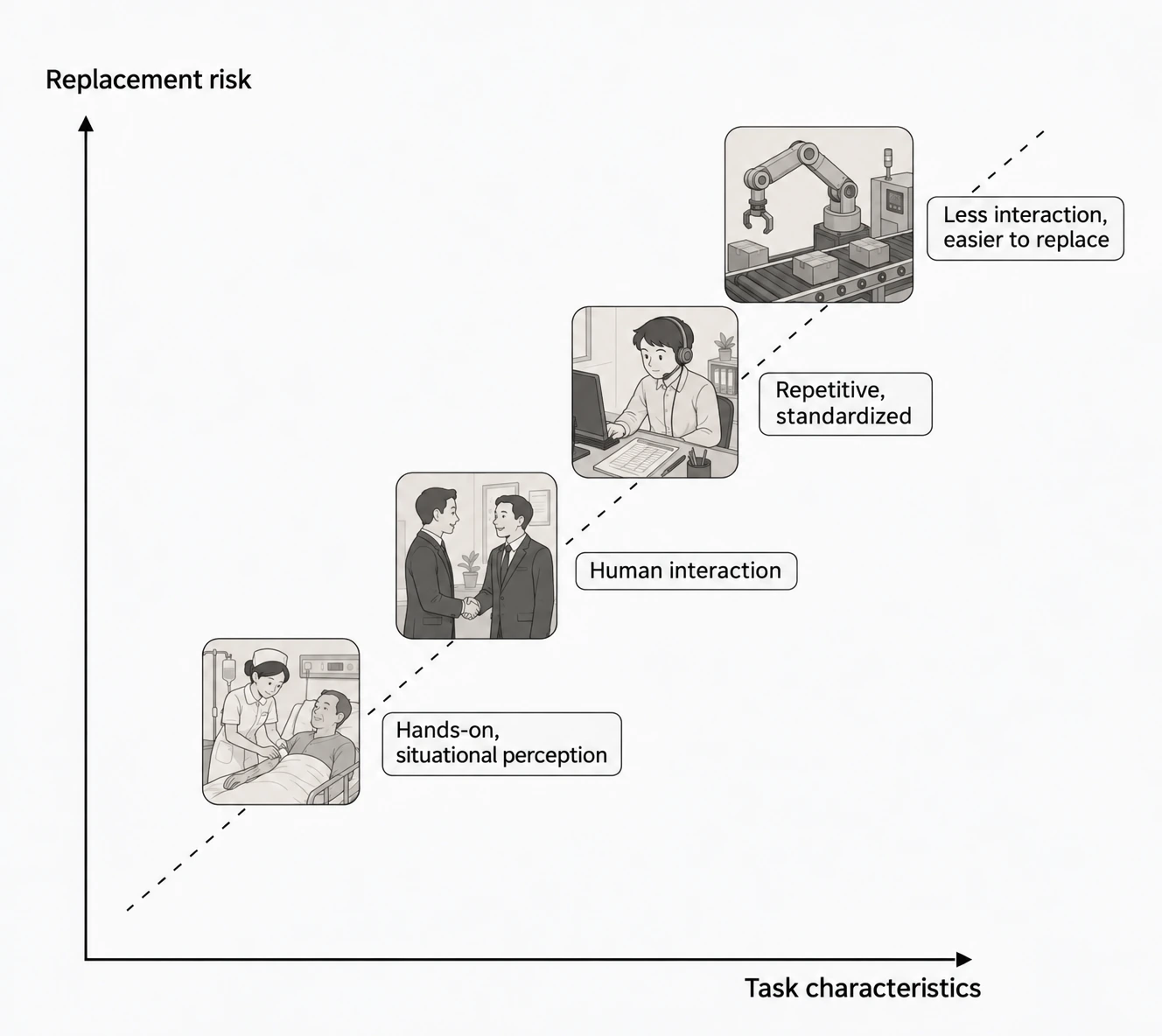
Microsoft's August 2025 report on the impact of generative AI on occupations found considerable overlap between white-collar tasks and AI capabilities. By contrast, heavy machinery operation, hospital nursing, and physical labor require hands-on work and on-site perception, making them relatively harder to replace.
The China Academy of Information and Communications Technology's White Paper on the Employment Impact of Artificial Intelligence (2026) reaches a similar conclusion. High-risk occupations tend to be repetitive, standardized, and low in interpersonal interaction, such as basic customer service, data entry, and assembly-line operations. Tasks requiring technical skill, creativity, and human interaction are harder to replace.
Both point in the same direction:
Repetitive, standardized tasks with little interpersonal interaction are easier to replace.
Tasks requiring physical action, situational perception, and interaction with people are harder to replace.
Second: economics
Organizational relationships help explain appropriate ways to introduce AI, but they do not fully explain differences in company performance after adoption.
Two forms of substitution are occurring: AI replacing people, and people replacing other people—a prospect that has become a widespread source of anxiety.
As discussed earlier, the economics of automation cannot be reduced to model fees versus wages.
Companies must also account for deployment, operation, maintenance, supervision, acceptance checks, rework, training, and process redesign. They must include customer loss, relationship damage, and opportunity costs caused by incorrect replies.
Human work also carries value that is difficult to price separately: a representative's sensitivity to a customer's emotions, a salesperson's experience handling exceptions, or a delivery team's judgment when conditions change on site.
An AI solution that appears to save labor may not reduce total costs. If faster output comes with more rework, supervision, and mistakes, the investment may not pay off.
Third: social impact
This is the assessment most easily overlooked. Its effects occur within organizations and extend into society.
The purpose is not to impose a moral burden on entrepreneurs. Social effects change employee morale and team dynamics, which directly affect organizational efficiency.
At the societal level, K-shaped economic divergence is intensifying. Capital pours into AI and embodied intelligence while other sectors recover slowly. Because employment and participation in these areas have relatively high entry barriers, wealth gaps widen further.
Automation must therefore be evaluated beyond task completion and short-term cost reduction. What happens to relationships when AI takes over this work? How does the surrounding social order change?
The history of the Industrial Revolution demonstrates the importance of all three assessments.
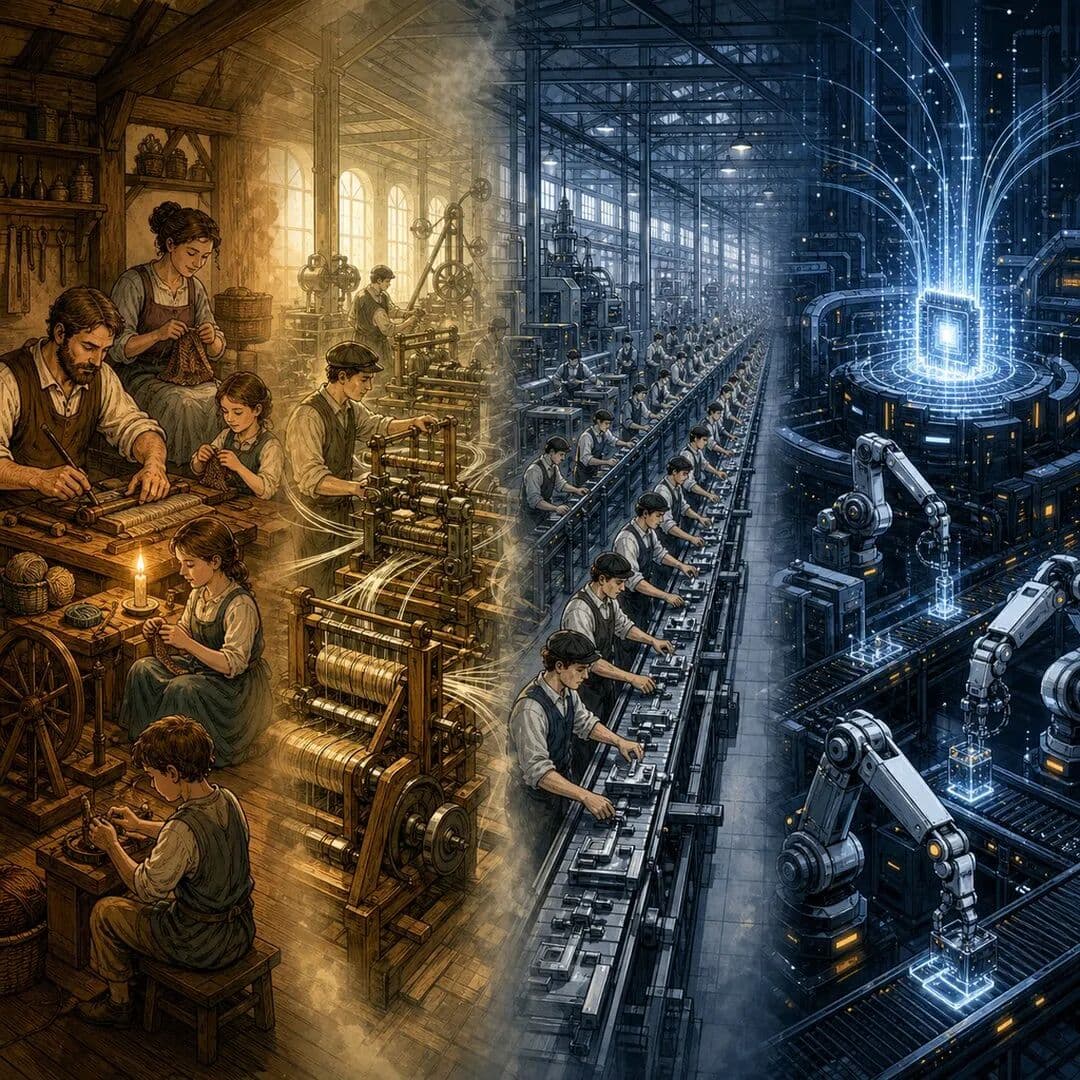
From Watt's improvements to the steam engine in 1765 to the completion of the Industrial Revolution in roughly 1830–1840, nearly a century passed.
Machines offered powerful production capabilities and clear economic value. But their arrival also disrupted workers' skills, wage structures, and established ways of life, requiring a long period of social adjustment.

The early nineteenth-century Luddite movement, in which workers destroyed machinery, concerned more than opposition to machines. It also raised questions about who would receive the gains from technology and who would bear the costs of transition.
05 | A game of chicken and a collective dilemma
If the investment is not automatically worthwhile, why do almost no companies stop developing and adopting AI? Why do individuals keep using it?
We are in something like a game of chicken: nobody dares fall behind.
When every potential job applicant and every industry competitor uses AI, individuals and companies keep going, even when they have a detailed accounting of the costs. Competitive anxiety makes stopping difficult.
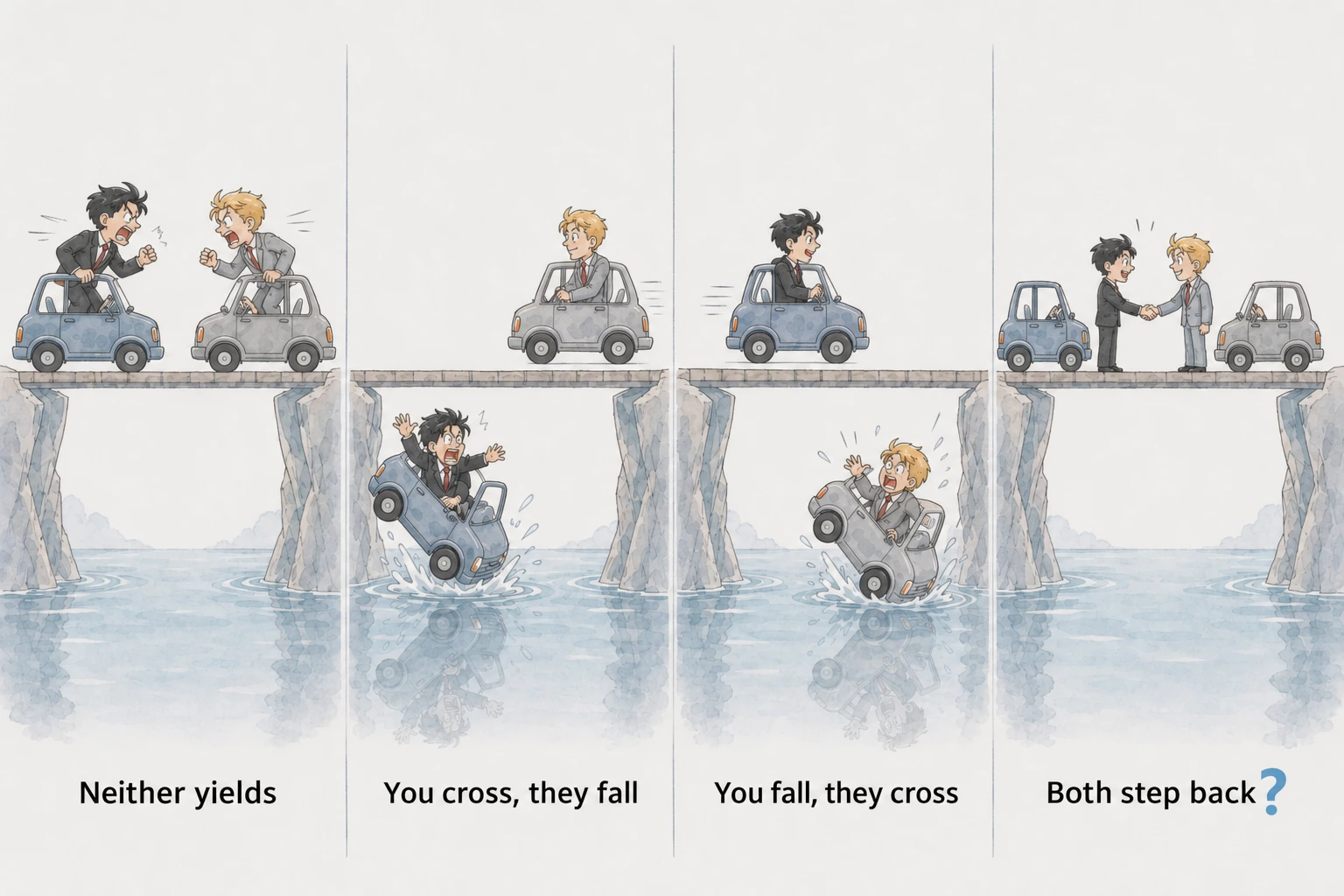
Individually rational decisions can add up to collectively irrational outcomes.
Everyone may end up worse off: machines take over steps that should have remained with people, and options for retaining people become difficult to recover.
In practice, however, many factors influence development, leaving its direction uncertain.
06 | Human value and potential barriers to AI adoption
One of the first factors that may prevent this outcome is people's examination of their own value and existence.
Ontology concerns the meaning of being.
As AI becomes more intelligent and performs cognitive work once considered uniquely human, how should we understand it?
If we habitually hand over judgment and creativity, what kind of people will we become?
We seem to be gradually losing the process of acquiring and practicing knowledge.
With AI, we can quickly read a major work or produce something meeting the baseline of a professional designer. Yet we also become more distant from the process of making it, and less able to say confidently that an article or presentation is our own work.
When people increasingly act only as agent managers, alienation appears to deepen. The purpose that makes us human becomes less substantial. People may begin to feel that AI directs them to supply tokens, rather than that they direct AI.
At the company level, treating people only as costs and means to organizational goals—while increasingly distilling their skills and collecting their data—can further erode their distinctive value.
Reflection on human value, alongside intellectual property and labor protection issues, will continue to shape the discussion of appropriate AI adoption.
For example:
- A company asks employees to upload personal materials to a shared knowledge base to build context infrastructure from historical knowledge.
- Departing employees are asked to hand over the agents on their computers unchanged.
- A company introduces specialized agents.
How can employees' concerns about losing knowledge, having their skills distilled, or losing their jobs be addressed?
The answer may be critical to the spread of the technology. Technical capabilities alone cannot establish these boundaries. Technology implements outcomes that are also shaped by social negotiation.
07 | People and AI under contractual governance
What kind of world will we enter, and how can we coexist with AI?
Two claims are common: AI is a superior form of life that will replace people; or people will always be superior, and AI is merely a tool. Both place people and AI in opposition.
Both overlook something essential: human beings do not have value as ends in themselves because they outperform AI. People are ends in themselves.
People set AI's boundaries, establish rules, assign responsibility, and give it purposes. AI operates within those boundaries.
Our position is that people and AI should coexist within governable relationships, with human purposes as the basis for governance.
Inside a company, this becomes a concrete institutional arrangement.
Zleap OS aims to establish a set of governance contracts across the company to regulate relationships between people and AI.
- Which project or department owns an agent, and what can it read or call?
- Which decisions must return to a person, including escalated exceptions?
- Who receives an escalation when a boundary is crossed?
- Who is accountable for errors, and can every step be audited?
This governs how agents work and clarifies ownership, access, escalation, and accountability within a shared organization.
An agent's initiative does not remove human authority. It can free human judgment from routine details to concentrate on direction, boundaries, and exceptions.
We will discuss how Zleap OS implements this, and our thinking behind it, in a future article.
References
- MIT NANDA (2025): State of AI in Business (2025), working paper.
- Stanford HAI, 2026 AI Index.
- Coase, R. H. (1937). The nature of the firm. Economica, 4(16), 386–405. Cheung, S. N. S. (1983). The contractual nature of the firm. Journal of Law and Economics, 26(1), 1–33.
- Microsoft, report on the impact of generative AI on occupations: August 14, 2025, https://www.toutiao.com/article/7537892548656824878.
- China Academy of Information and Communications Technology, White Paper on the Employment Impact of Artificial Intelligence (2026): May 31, 2026, https://www.toutiao.com/article/7645899551735415359.
Keep reading
Insights
The Coordination Deficit: Individuals Accelerate, Enterprises Stall
Why individual AI productivity does not automatically improve organizational performance, and how shared knowledge, agent governance and field implementation can help.
Insights
From Transformer to Transformation: Challenges and Paths for Enterprise AI
Seven challenges in enterprise AI use and organizational relationships, and two paths forward through context infrastructure and organizational integration.
Technology
SAG Paper V2 Is Here
SAG V2 improves pruning and evaluates retrieval, question answering, dynamic hyperedges, entity handling and large-scale queries.